Tuesday, September 17, 2013

Turning the Corner - Part 3 of "First to What?"

Although initially dispirited after the 1901 gliding season was ended, Wilbur soon recovered his natural optimism.  After only 2 weeks, his sister Katharine commented "We don't hear anything but flying machine and engine from morning till night....."  In September of the next year (1902), Wilbur made a presentation to the Western Society of Engineers, in which he recapped the Wright's experiments to date, and his comments were published in their transcripts, which were highly sought after by fellow experimenters.

Wilbur and Orville had become suspicious of Lilienthal's list tables, which they now thought may be in error, and also wondered if Smeaton's cofficient, used to calculate lift and drag for an airfoil, was also wrong.  At the time, Smeaton's coefficent (k) was thought to be 0.005, but it had also been experimentally measured as being anywhere between 0.0027 and 0.0054, albeit with poor instruments.  The US Weather Bureau had started to use k=0.004 instead.

The first test rig

To test their ideas the Wright's placed a small wheel horizontally on the front of one of their bicycles that balanced the drag from a plate of known size against the lift of an airfoil, but they found speed control difficult.  However, their early results seems to confirm their doubts in both Lilienthal and Smeaton.  So Orville, the most practical of the two brothers, made a small 18" long wind tunnel with a fan to generate airflow and vanes to ensure the flow was turbulence free.  They also created a very innovative way to measure lift and drag, again balancing the unknown force against known drag from flat plates also exposed to the same airflow.  In this way, they could make precise measurements of force, without having to measure force directly with springs and complicated mechanism.


The Wright's larger wind tunnel


In October 1902, Wilbur wrote to Octave Chanute, saying that "Lilienthal's table is very seriously in error".  Armed with this data, and using the results from their 1901 glider, the Wrights had calculated Smeaton's coefficient to be 0.0033, which is within a few percentage points of the value accepted today.  Using the new value for k and a new larger wind tunnel they built in October 1902, the Wright's tested a variety of airfoil shapes.  Although the wind tunnels are lost, the balance mechanism and drag plates are on display at the Smithsonian museum.  With the correct value for k in hand, Wilbur recalculated the proper coefficient of lift (CL) for their airfoil designs, and determined which wing shape was optimal for the speeds they flew.

Now the Wrights could design an airplane and know the critical functions of lift, drag, and glide angle (or power needed) in advance.  They had become the first true aeronautical engineers in the sense that their future designs were engineered for a specific level of performance, not just built in hope they would get off the ground if they were lucky.  They were also fully controllable designs with moveable airfoils, not just weight shifting.

Now the Wrights built a new glider, the 1902 glider - the first engineered aircraft.  They shipped it South to Kill Devil Hills in the September of that year, where Octave Chanute visited and brought, really against the Wright's desires, a few of his designs for "comparative testing".  The Wrights by this time were so far advanced that they already knew those designs were flawed and why they wouldn't fly, but not wishing to hurt the old man they accepted his gliders, but spent as little time as they could with them.

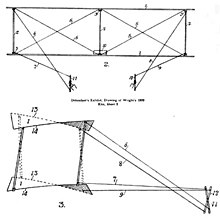
The 1902 glider was the largest aircraft built to that time.  The wings were longer and narrower (high aspect ratio), which they now knew reduced parasitic drag.  The airfoil had a camber of 22:1, and wing area of 305 feet.  It flew marvelously.  The Wrights started flying it a kite, and immediately noticed that it's lift was enough to make the wires almost vertical, rather than at the substantial angle of the 1901 glider.  The wing flew at a substantially lower angle of attack, and generated much less drag, with a glide ratio about 10:1.

The 1901 and 1902 gliders flying as kites (see the difference?)

Wilbur make the first flights, making glides of over 500 ft, and finally Orville took the controls of an airplane for the first time.  In the first 3 days they had flown further than their previous two trips combined.  One control problem remained, the strange "Well Digging" behavior when in a banked turn, named because the low wing would leave a crater in the sand as it dropped and pivoted.

Today we know this as "adverse yaw", a phenomenon caused by the increasing lift on the rising wing, which since drag is proportional to lift, also increases the induced drag for that wing.  As a result, the nose is pulled in the opposite direction to the turn, something we overcome with applying rudder in the direct of a "coordinated turn", one of the first things a student pilot learns (especially in a glider).  At the low speeds the Wrights flew, just above the stall, pulling the rising wing backwards would yaw the glider into a side slip, dropping the low wingtip into the ground.

Wilbur flying the first true airplane - with dual fixed vertical rudders (later replaced with a single moveable one)


Orville invented the next innovation, a movable vertical stabilizer/rudder.  Wilbur, the more experienced pilot, recognized that with their limited controls of the time, a third control would be too much, and proposed tying the moveable rudder to the wing warping controls, inventing the coupled turn used on many modern aircraft, such as the Beechcraft Bonanza.  Around the same time, the Wrights re-rigged the glider to have drooping wingtips, inventing dihedral wings (although most wings use positive dihedral today, some still use negative dihedral or "anhedral", as did the Wrights).

With control over all three axis, the Wrights never again experienced well digging, and the airplane was substantially invented in 1902.  That year, the Wrights made nearly 1,000 flights, with the longest being 622 ft and lasting 22 seconds.  Enthusiastically, and in great contrast to the previous year, Orville wrote home "We now hold all records!"

Thursday, June 27, 2013

Onward to Kitty Hawk - part 2 of "First to what?"

So far, the quest to fly had been Wilbur Wright's alone.  in the summer of 1900, he engaged some of the rest of his family - Orville, with whom Wilbur designed and built the 1900 glider, and Katharine, who helped sow the fabric for the wing covers.  Katharine doesn't get as much credit as she should, because she didn't go to Kitty Hawk and attend the test flights. And test flying is what they did at Kitty Hawk, for the next 4 autumns.

The Wright's bicycle shop was their source of income - the Wright's built their bicycles in the winter and spring months, so that they had stock to sell in the Ohio summer.  Once the shop was stocked they could use their workshop for other things, such as airplane design.  Once the summer bicycling season was done, they could spend a few months getting away - and flying.

In the Autumn of 1900, Wilbur traveled to for the first time to Kitty Hawk with his glider - their research had suggested that the autumn winds were favorable for test flying there.  Orville followed after Wilbur had set up camp, and Orville had closed the shop.  They initially flew their glider as kite to test out its lifting and wing warping controls.  Due to unavailability of 18 ft lengths of spruce in the area, Wilbur instead used 16 ft length of white pine to make the wing spars, substantially reducing the wing area.

The 1900 glider flying as a kite


The glider flew well despite the shorter wings, and Wilbur began free glides down the sand dunes, mostly short and low to the ground.  They were concerned about avoiding the not-well understood stall phenomenon that had killed Lilienthal, and had determined to control their risk by flying low and using a "canard" design with the fixed elevator  in front.  Pitch control was by weight shifting, but roll was controlled by wing warping.  The Wrights were encouraged by their beginning, and Orville began to become as invested as Wilbur in their project.

The Wrights were wise to fly low - several times the gliders's main wings did stall, but with the canard elevator, instead of a fatal pitch down, the glider just settled to the ground in a flat attitude, leaving both man and structure intact and undamaged.  The wing warping system worked well, and Wilbur was able to make controlled turns - an aviation first.

Feeling that they were making good progress, in the spring of 1901 Orville and Wilbur began designing a new glider - bigger, and with a moveable elevator - the biggest aircraft yet flown and built to their design using all the best data available from Octave Chanute.

The larger, but disappointing 1901 glider


Dan Tate and Orville Wright launch Wilbur in the 1901 glider
The 1901 glider was a disappointment.  The Wrights had used Lilienthal's lift tables and Chanute's suggestion of a 12:1 wing camber instead of the 22:1 camber of their 1900 glider (the camber is the ratio of the wings length from front to back, divided by the height of the wings maximum curvature at its thickest point).  The resulting lift didn't match what the tables said it should - it only generated about 1/3 of their calculated value, and was substantially more draggy, having to fly at an exaggerated pitch up (angle of attack) to generate enough lift to carry a man.  The pitch control was erratic and not fast enough.  They experimented with a smaller control surface, but the problems remained.  Still Wilbur (who did all the flying) was able to get some long glides and built up his level of flying experience - and suffered some serious stalls, fortunately all at low level and slow speed, and the damage to pilot and machine much reduced thanks to their "backwards" design.  The picture above shows Wilbur flying the glider, with Orville and Dan Tate holding the wings.  You can clearly see the greater wing curvature and the moveable forward mounted elevator.  You can also see the open area below Wilbur - allowing him to supplement the elevator pitch control with weight shifting.

The 1901 glider continued to show the value of wing warping, able to make controlled, banked turns most of the time, but showing an odd tendency to sometimes turn the opposite way - pivoting around the raised wingtip. The Wright's left North Carolina discouraged, Wilbur commenting to Orville that men would not fly for fifty years.

Tuesday, June 25, 2013

The First to (what?) - Part 1

Invention is often portrayed in the movies as a "eureka" moment of inspiration, followed by effortless triumph.  In reality, it's a lot more work.  Before developing the incandescent light bulb, Edison tried an unknown number of things, and was quoted saying 'I have not failed. I've just found 10000 ways that won't work.'

The Wright Brothers, Orville and Wilbur, are often described as "the first to fly".  They were not - even if you don't count balloons, quite a few people had lifted off Terra Firma in heavier-than-air machines before December 17, 1903.  Their real achievement was to engineer the first practical and controllable airplane, and then fly it - in 1905.


Sir George Cayley, 6th Baronet of Brompton, didn't himself fly in his glider.  Being a nobleman and memeber of parliament, he had one of his employees fly - his coachman - who promptly resigned, saying that he was employed to drive, not to fly.  The picture below shows a replica flying in 1973, since photography hadn't been invented in 1853.  His main contribution to aeronautics, is that he was the first to identify the four primary forces acting on an aircraft, that we all learn as student pilots - weight, lift, thrust and drag.

File:Cayley Glider Replica Flown By Derek Piggott 2.jpg
A replica of Cayley's 1853 design, flown 120 years later


Otto Lilienthal approached flying in a systematic way, creating a series of gliders that he flew down hills in Germany.  His main contribution was to test a series of airfoil shapes, and develop lift tables.  His gliders used a bar which he held, and used weight shifting for control - just like a modern hang glider.  Unfortunately on 9 August 1896 a sudden wind gust caused his glider to stall, and his weight shifting was insufficient for recovery.  He crashed and died.

File:Otto Lilienthal gliding experiment ppmsca.02546.jpg
Lilienthal flying one his gliders in the late 1890s


Octave Chanute was a French railway engineer who moved to the USA as a child.  He designed many railway bridges and yards throughout the Midwest, but turned as an older man to aviation.  He was too old to fly himself, but engaged Augustus M. Herring and William Avery as substituents.  His primary contribution to design was the biplane glider, reasoning (based on Lilienthal's tables) that more lifting surface was needed, but the scale could be kept under control by decking the wings.  His largest design used 12 wings stacked one on top of the other.  His secondary contribution was to act as a kind of manual bulletin board for the science of aviation, informing all the world's pioneers of the discoveries and activities of others in the field.


File:William Avery Chanute glider 1904.jpg
Augustus Herring preparing to fly a Chanute "double-decker" glider


Enter the Wrights.  In 1899 Wilbur wrote to the Smithsonian Institute and started a voluminous correspondence with Chanute, gathering and learning from all who had gone before him (most competitors didn't take such a systematic approach).  Learning that people knew how to get off the ground, he identified control as the main issue, and had his nearest approach to the "eureka moment" when he conceptualized twisting the Chanute double decker to achieve "wing warping".  He built a glider using wing warping, and flew it as a kite that summer - demonstrating that he could control the kite.  The Wright's most important contribution was also their first.


Wilbur Wright's 1899 glider/kite using wing warping

Wednesday, June 19, 2013

In The Beginning - (Warning, this post make religious statements!)

So it says at the top that this blog will cover several topics, one of which is religion.  I've kind of nibbled around the edges with more philosophical musings, and some thoughts on the philosophical and religious implications of modern science, specifically quantum mechanics. 

This one's different.  I'm going to take on a central tenant of some Christian churches, namely, what is the Word of God?

Without getting into which is which, some denominations state bluntly that the Bible is "The Word Of God", inerrant, the source all dogma and the founding "constitutional" document to which all questions are referred.  A friend recently posted on his Facebook page that the Bible held up well against other similar ancient documents when compared to archeological research, but I think this misses the point.

The claim is that the Bible is the actual verbal or written musings of an omnipresent, omniscient being who transcends space and time.  Yet the Bible is full of things that contradict modern knowledge, scientific and archeological:

  • The 7 Day creation.  If this is true, then a whole lot of science is invalidated, or vice verse.  You can't have both The Bible and evolution be true at the same time, no matter how many impossible things you might believe before breakfast. The only consistent, logical outcome is to believe in one, and dismiss the other as untrue.  Those who reject science in favor of creationism are at least being logical, if misguided.  Personally I prefer to follow the evidence from astrophysics, geology, biology, chemistry at just about every other branch of physical science.  The evidence for evolution and an ancient Earth is overwhelming.
  • The Global Deluge.  Nice story of Noah and his Ark, but there is not geological evidence to support it.  There are similar flood stories in many cultures, which some say shows it likely happened, but I think, given the claim of inerrancy in the source material, (Genesis,) it shows the opposite - a common folk tale told as fact by a writer in antiquity.  Some think the flood tale may be the result of the creation of the Caspian or Black Seas, as sea levels rose and the Mediterranean broke into what were agricultural lowlands in the ancient Fertile Crescent.
  • The Israelite Sojourn in Egypt.  This is the well known story of how Joseph led the Isrealites into Egypt, where they were enslaved by the Pharoahs and forced to build the pyramids, until God caused Moses to lead them into the Promised Land, breaking the Egyptian chains with plagues and parting the Red Sea.  The trouble is, that only the Hebrew Bible tells that story, no other sources (such as Egyptian tablets and scrolls) make mention of the rather dramatic events.  Wouldn't you think the Egyptians would have made some note of such things?  And that prior to Moses, we would find things like slave auction notices and bills of sale, which we do from almost every other slave holding culture?  The genetic evidence shows that the Isrealites were actually Canaanites who developed a separate culture in place, and the Exodus is just a founding myth (that has been extremely effective).
  • Many other tales miracles in the Old Testament.  For example, the tale of a Judge (Samson) whose physical strength was proportional to the length of his hair (a very similar tale spread in dark ages France about the Merovingian kings, who wore their hair long and claimed they could not be beaten in battle - until they were).  The walls of a city (Jericho) falling to the sound of trumpets.  Apologists try to find explanations for all of these, but either they were bona fide miracles (that don't happen today) or they are myth, legend or simply embellished history.
I'm perfectly fine with the idea that the Old Testament/Pentateuch etc are a mixture of myth, legend and real history, as some of it surely is - for example the capture of Isreal by Darius in the great Persian Empire.  Where I diverge is the idea that the Old Testament can be the work of God (as an author), and in particular be the "Word" of God, this omniscient, omnipresent, transcendent being.  How come He didn't get His facts straight?

The New Testament is somewhat different. I'm not going to get much into whether it is historically accurate - in fact it seems to be very accurate indeed, although a couple of straight forward self contradictions are recorded.  For example, how did Judas the Traitor actually die?  Matthew 23:3 says he hung himself in remorse after returning his blood money to the priests and elders.  Acts 1:18 says Judas used the money to buy a field, and there he fell over and his body burst open, and he died.  They can't both be true.    Also, although Mark, Luke and Mathew agree on the basic narrative, they disagree on the order things happened, and when they quote Jesus, the words are not the same.  Not quite an inerrant recording of events, in any case.

So what's my conclusion?  I think the Bible says what it really claims to be: "holy men of God spake as they were moved by the Holy Ghost" (2 Peter 1:21).  And the key part is here, at the beginning of the Gospel of John: "In the Beginning was the Word, and the Word was with God, and the Word was God", followed by "The Word became flesh and dwelt among us".

Isn't it clear that no written thing is the Word of God?  The Bible makes it very clear that it doesn't claim that for itself.  It (or rather, John and Saul/Paul) makes the claim that Jesus = The Word of God, although according to the four gospels, Jesus never called himself that.  He said he was "The Son of Man".  But that's a different topic altogether.


Sunday, June 16, 2013

Illegal Alien - and Ace Fighter Pilot


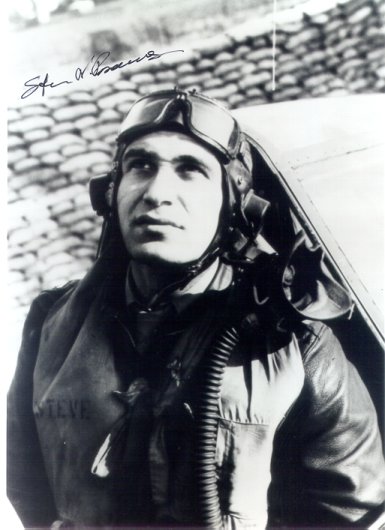
In the movie version of the book, "Forrest Gump", the hero just manages though pure serendipity to be present at almost every great event in the 1960s and 70s.  Spyridon "Steve" Pisanos was in many ways the Forrest Gump of World War 2.  Known then as "Spiro", he was the third child from a family of six, born in late 1919 into a working class family in Athens, Greece.

When he was a boy of twelve he noticed a humming sound, and saw a biplane from the Hellanic Air Force buzzing nearby Kolonos Hill.  Like many of us, from that time on he possessed a burning desire to fly.  But his family had no spare money, so he contented himself with cutting classes and going most days to Tatoi aerodrome, where he would watch the airplanes coming and going.  Eventually that summer, he became braver and found a gap on the fence and walked onto the field.  No-one paid any attention, and on later visits, he befriended some of the mechanics and started doing odd jobs.

Eventually the squadron leader noticed him and discovered he was an interloper.  Kindly, he turned a blind eye, and also counseled him of how to get into the air force - which would cost money his family didn't have and would take better grades that he was getting.  His frequent missing of school eventually caught up with him, and his father told him the facts of life - that flying was dangerous and expensive and he would never be able to do it.  He tried to build his own airplane from broken down car parts, but abandoned the attempt and buckled down to get out of high school.

Realizing that life in Greece wouldn't permit him to follow his dreams he decide to leave, and go to America.  He couldn't afford to buy a ticket, so he joined the merchant navy seaman's union and started working below decks as a fireman on a freighter  His job was to move coal from the bunkers to the boilers, where the stokers would add it to the fires.  His plan was to wait for the ship to visit the USA, and jump ship.

In the Spring of 1938, his ship entered Baltimore harbor.  Early on a Sunday morning, he climbed over the side and bummed a ride from a small boat delivering newspapers.  He only knew 2 words of English - "New" and "York" - where the ex-patriot Greeks lived.  Using this limited knowledge he bought a train ticket and made it to New York.  Leaving the station, one of the first things he saw was a movie theater with a Greek flag - the theater was showing the first Greek-made movie.  Standing outside of it, he heard young male voices speaking Greek.  His two new friends took him under their wings, gave him a place to stay and showed him how to sign up for a job at an employment exchange that was run by a Greek.

Spiro started working as a soda-jerk in a Greek-owned restaurant on 149th and Broadway.  He slowly started teaching himself to read English. Saving his money, that summer he went to Floyd Bennett field and took his first flight, in a Waco biplane.  The Italian instructor told him he needed to speak better English, so he took lessons and eventually started flight training in a J-3 Cub in August 1938.

Money was a challenge, so he changed jobs and moved to Plainfield New Jersey where rent and flying cost less.  He took a job at the Park Hotel in Plainfield, and continued his lessons at Westfield airport.  In February 1941, the INS caught him.  Fortunately for Spiro, by this time Greece had been invaded and was under Nazi occupation, giving him the status of refugee.  Also in his favor - the INS agent was himself a refugee and prior illegal immigrant, from Germany.  Spiro got his green card, and was now a legal immigrant. In July of that year, he got his private license and flew whenever time and money permitted.  He felt like the happiest man on Earth.

A month later, he learned that Royal Air Force was recruiting American pilots to create an "Eagle Squadron" to fight the Germans.  Armed with his brand new FAA license, he presented himself and was accepted.  At that time US citizens who signed up to flight for the British and Canadians risked loosing their citizenship, but Spiro wasn't American.  In November 1941 he was asked to report to a flight school in Glendale CA, where he met the rest of the motley crew.  While he was there, Japan attacked Pearl Harbor and Germany declared war on the US.

In the cold of a 1942 Canadian winter, Spiro and the rest of his squadron reported to the RAF in Montreal to be officially inducted into the British armed forces.  They crossed the Atlantic by ship and started training at RAF Cosford - beginning with how to march and how to salute, and ending with flying the Hawker Hurricane.  In July 1942 Pilot Officer Pisanos was posted to 268 squadron, flying the North American Mustang I (known to the US Army Air Force as the P-51A).

Late in August, the Greek Air Force in exile tried to grab Spiro to fly for them as they reformed their air force flying in North Africa.  In order to short circuit their attempt, Spiro (now "Steve") wrangled a transfer to 71 "Eagle" squadron - one of the three all American squadrons flying Supermarine Spitfires.


The following month, the three Eagle squadrons were transferred into the US Army Air Force, which was disaster for Steve, since only Americans could fly for them.  However, cooler heads prevailed and Steve was made a 2nd Leutenant in the USAAF - and soon afterwards what was now called the 4th Fighter Group traded their Spitfires for P-47 Thunderbolts.  And on May 3rd 1943, the US embassy asked him to attend a special meeting where he was made a US Citizen, the first to be naturalized on foreign soil.  Edward B Murrow of CBS reported on it in his radio broadcast, and the story made the Stars and Stripes newspaper.  Six days later, Steve got his first kill, a German FW-190.

Soon after, Walter Cronkite interviewed Lt. Steve Pisanos, something that Cronkite remembered later because as he was leaving, Steve buzzed Cronkite's car with his P-47 at very low level - his way of saying "Farewell!".

Early in 1944, the 4th Fighter group was re-equipped with P-51B Mustangs. The Rolls Royce Merlin engines gave a lot of problems initially due to defective spark plugs and problems with fuel quality.  In early May 1944 after shooting down his 4 enemy fighters in the same mission (making his score 10 confirmed), Steve's engine failed during his return flight.  He made a successful belly landing between Le Havre and Évreux in German-occupied France.  Evading capture with the help of the French Resistance, he was hidden in Paris awaiting a chance to escape through neutral Spain.  In the meantime, he went on several raids with the Resistance, until on June 4th, the D-Day invasion changed all of his plans.  With the US and Free French armies approaching Paris, the Resistance began daylight fighting with German occupying forces, with Steve Pisanos fighting alongside them.  On August 23rd, the US 4th Infantry Division reached Paris and Steve was liberated, along with some other US airmen with his group.

On his return to the 4th in England, he learned that he couldn't continue to fly combat missions since he knew too much about the Resistance which he might be forced to tell if he was captured.  Promoted to Captain and reassigned to Flight Test at Wright Field, in Dayton Ohio, he first went to Muroc Field (now Edwards Air Force base) in California to attend Test Pilots School (and met the famous Pancho Barnes), flying the first American jets (the P-80) and captured Germany aircraft such as the Me262 jet.  Soon Captain Chuck Yeager and Lt. Bob Hoover joined the flight test team along with Gabby Gabreski, Don Gentile and and Dick Bong - all famous pilots in their own right, either then or later.

In January 1946, Steve left the Air Force to become a pilot with TWA.  Shortly after that, he met his future wife, Sophie Pappas.  They married in June 1946.  The uneven life of an airline co-pilot and frequent furloughs took their toll on his small but growing family, and in October 1948 he rejoined the renamed USAF, again flying as a test pilot on F86 and F-100 aircraft.  As a full Colonel, he served in Vietnam in the late 1960s, but his career came full circle when in 1974 he was assigned to the USAF delegation integrating the McDonnell Phantom II into the Greek Hellanic Air Force squadrons flying out of Tatoi airfield, just outside of Athens - the same airfield where as a boy he had cut classes to stand outside the perimeter fence, wishing to fly.


For more details, see his wikepedia page.  At the time of writing, Colonel Steve Pisanos is 93, and lives in San Diego.  http://en.wikipedia.org/wiki/Steve_Pisanos

Friday, May 31, 2013

D.B. (the first one)


This is the first of what might become a series.    When I was a child, and even today, many of my heroes were pilots.  Since I was born in the late 1950s, pilot stories of my youth were dominated by World War II, which to me seemed ancient history - but with the advantage of experience and histrical context I now realize it had only recently ended and shaped much of the world I grew up in.  In many ways the history of the 20th century can be seen as one long struggle between the rising powers of Russia, Germany, Japan and the USA, with the declining powers France and the British and Ottoman Empires, starting in 1870 with the newly unified Germany defeating France, and not ending until the fall of the Soviet Union and collapse of the Warsaw Pact in 1989 and 1990.

I spent my childhood and got my education in England, and have spent nearly all my adult years in America.  Initially my flying heroes flew for the RAF and RCAF, and only later did I learn much about America's flying heroes Dick Bong, Hub Zemke and others.  By the way, for my American readers, did you know Charles Lindbergh was the 27th person to fly across the Atlantic?  He wasn't even the first to do it non-stop?  He just had better PR.  Later still I learned about Luftwaffe aces Macky Steinhoff, Adolf Galland and Eric Hartmann, and Japanese aces like Subaro Sakai.  It took years to realize that they weren't necessarily better men, or even better pilots - they were better warriors.

So I'm going to introduce you to a British ace who was a better pilot, and a great leader and fighter.  As a man he had his flaws, but sometime history rises to meet the person and shows his or her greatness.  British and Canadians know him, but most Americans do not.

Douglas Bader was born in 1910 in England, although his parents, like many of the time, lived in India, where they returned almost immediately after his birth, leaving him with relatives.  Only after two years did he rejoin his mother and father in India.  Shortly before World War 1, the family returned to England, and soon afterwards Douglas' father was wounded in the trenches and later died.  His mother re-married to a church of England clergyman, and Douglas was sent off to boarding school.  There he neglected his studies, but became a well regarded sportsman, playing Cricket, Boxing and Rugby with fervor.

When it came time to leave, he determined to join the Royal Air Force (RAF) as cadet at Cranwell, the RAF officer training school.  He had to take extra lessons to pass all the academic criteria, but succeeded and won a full scholarship.  At Cranwell he learned to fly and to pass the technical ground school, and again excelled at sports - stubborn, arrogant and cocky, he was selected for fighters and was posted to 23 squadron in 1930, flying Gloster Gamecocks - a slow but agile biplane little different from World War I fighters like the Sopwith Camel.

In those days squadrons were also training schools, and his flying training continued - and Bader excelled at that too.  By the next year he was selected to fly in the RAF's precision flying display at the Hendon Air Day - a precourser to the Red Arrows formation flying displays at Farnborough.  He was also selected to play cricket and to box for the RAF teams, and to play rugby on the England national team.  Before that game could take place however, his cockiness and unwillingness to back down from challenge caught up with him.  Challenged to do low level aerobatics at Woodley Aerodrome near Reading England, he initially declined, and when accused of being "windy" he angrily took up the challenge and crashed performing a low level roll.

The wreck pushed the rudder pedals through his lower legs.  At Reading hospital, both legs were amputated - one above the knee and one below.  When ready, he was fitted with two artificial legs - but stubbornly he refused to walk with a cane.  The RAF sent him to Central Flying School to see if he could still fly, which he succeeded at brilliantly, despite having no feeling in his (artificial) legs.  Because the RAF had no regulation permitting a legless man to fly, he was re-assigned to ground duties, and finally left the service with a pension, 100% disabled.

Bader got a job in the City of London working for Shell Oil, in their aviation fuels office. While recovering from his accident, he had met his future wife Thelma, and they married.  His competitive drive undimmed, he took up golf (and became good enough to play in pro-am tournaments) and unbelievably, squash - a game played with racquets and a bouncy ball in a small room, very similar to racquetball.  In 1938, the RAF started rapid expansion, and Bader got confirmation that they would take him back if war made it necessary - he started praying for war with Germany.  It came on September 3rd, 1939.

Bader rejoined the RAF and was sent to flying school, and passed rated as "exceptional".  He passed his medical, but retained his disability pension - officially 100% fit and 100% disabled - at the same time.  He was posted to 19 squadron as a very elderly Pilot Officer (2nd Lieutenant), flying Mark 1 Spitfires.  He was rapidly promoted to Flying Officer, and was sent to 222 squadron as flight commander, also flying Spitfires, just in time to cover the British Armies evacuation at Dunkirk.  There he shot down his first aircraft, a bf109 and probably shot down a Heinkel 111.  Or probably not - over-claiming was rampant in the RAF, especially over enemy held territory.  The RAF over-claimed about 3 to 1, about the same at the US Army Air Corp fighter pilots. 

File:Douglas Bader.jpg


RAF 242, a Hurricane squadron was withdrawn from France soon after, and its Canadian pilots lacked a squadron leader, the last being killed in France.  Placed in 12 Group it needed a strong leader, and Bader was transferred as acting Squadron Leader (Major).  The role of 12 Group was to guard the English industrial midlands from air attack, and to back up 11 group in the south.  Flying alone in bad weather, Bader soon shot down a Dornier 17 bomber off the coast of East Anglia.  Finally, in August 1940, 242 squadron was thrown into the Battle of Britain, asked to cover the North London sector.
 The squadron did well - the experienced Canadian pilots experience and skill worked together with the calm, confident leadership of Bader to become extremely effective, and Bader was given operational command over first three, then five squadrons, which he operated as the "12 Group Big Wing".  12 Group had the luxury of time to gather a big wing, being further from the French coast, while 11 Group operated their squadrons singly, or in pairs.  Even so, 12 Group was often late arriving, hitting the bombers after they had bombed their targets.  Since many of these targets were 11 Group airfields, some bad feeling arose between the group leaders, Leigh-Mallory of 12 Group and Park of 11 Group.  The 12 Group fighters way over-claimed, but being hit by up to 60 British fighters at once demoralized the German pilots.  Finally Hitler ordered the Luftwaffe to attack London, bringing the bulk of the fighting within range of Bader's squadrons, who feasted on the often unescorted medium bombers.

By the end of October, the Battle of Britain was winding down, and the Chief of Fighter Command, Sir Hugh Dowding, retired. Leigh-Mallory was chosen to replace Keith Park as head of 11 Group, and he brought Bader with him.  Douglas was promoted to Wing Commander (Colonel), and given command of the three squadrons based at Tangmere, on the South coast.  In the spring of 1941, the RAF began offensive operations, the daylight bombing of occupied French facilities and airfields near the coast (the RAF was also night bombing Germany, rather ineffectually).  The Tangmere wing was called on to escort them, and to perform fighter sweeps over Northern France.

At this point, Bader introduced his most important innovation, the "Finger Four" formation.  It was derived from a German formation, but was modified for the British way of operating.  The Finger Four was flexible, suited for both offensive and defensive maneuvering. This formation replaced the line astern and 3-plane "vic" formations used by the RAF before, and was later adopted by the US Air Force and used all way into the Vietnam era, before being replaced by the "loose deuce" and "fighting wing" 2-plane formations used today.

Tired and overdue for a rest, in August 1941 Bader allowed himself to become separated from the rest of his wing, and was shot down (he always claimed a Messerschmidt 109 collided with him, but the evidence is that he was shot down, possibly by one of his own pilots).  One of his legs got stuck inside his Spitfire, and he bailed out with only one leg attached.  The Germans placed him in a hospital under guard, and the RAF dropped him a spare leg.  Mobile again, he escaped by climbing down knotted bed sheets from his 3rd floor window, but was recaptured the next morning, and sent to Germany and a POW camp.

He became an incorrigible annoyance to the German guards, baiting them and attempting to escape several more times.  He was transferred frequently, and narrowly avoided being part of the the "Great Escape", in which 50 POWs were murdered by the Gestapo.  With his record, he would likely have been one of those killed.  Finally, in exasperation, he was sent to "Colditz", an escape proof prison in a castle in a hill.  Several more escape attempts failed, and eventually he and his co-prisoners were freed by the US Army in 1945.

Returned to England, he was promoted to Group Captain, commanded the RAF's tactics school, and flew the first jets.  But the thrill of combat was gone, and Shell Oil recruited him back with the offer of a Vice President's title and his own private aircraft (his last one was a Beechcraft Bonanza).  He flew all over the world in his airplane, was knighted by the new Queen, and played golf against the very best.  In 1982, Sir Douglas Bader died after speaking at a dinner in the London Guildhall (where I had just received my bachelors degree in aeronautical engineering 17 months earlier, before moving permanently to the USA).  For more details, see the Wikipedia page here: http://en.wikipedia.org/wiki/Douglas_Bader.

Bader was immortalized by Paul Brickhill in his book "Reach for the Sky".  As a teenager I read that book over and over.  I liked the flying parts the best, but now, having found a copy on Amazon, I am more taken with how brave, determined and stubborn he was, and how that was both an aid (he used them to learn how to walk on his "tin legs") and a hindrance (he refused to admit it if he was wrong).  The book became a movie starring British actor Kenneth Moore, and Bader himself authored a book on World War 2 fighter tactics, called "Fight For the Sky" (in my collection).

I also have a poster depicting his Spitfire Mk 5a and a bf-109F in combat in the spring on 1941, signed by Bader himself and his great war time enemy and post-war friend, General Adolf Galland.  It is hanging in the front hall.  I saw him once, from a great distance, at an airshow in Nottinghamshire.  But I recall being more interested in the Spitfire and Hurricane aircraft parked near him - I was 15.

By the way, my English Springer Spaniel is named Douglas - after this man.

Monday, May 6, 2013

Trip Planning

There's a big spring conference coming up in two weeks in Las Vegas.  I've attended nearly every one for the past 18 years (I missed 2000 because I was living in England at the time).  This is "Wireless 2013", put on by the Cellular Telecommunications Industry Association, or CTIA.  Insiders usually refer to it at "CTIA", not by its official name.

CTIA 2013™ Logo

Normally I go representing my employer, to put on an exhibit, meet with customers, or speak in a "track", a series of presentations about some burning topic of the moment. Since I'm currently unemployed, I'll be representing myself, using my network to help find that next opportunity, and using my airplane to get there and back on my schedule and my terms.

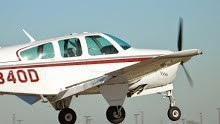
From North Dallas to Las Vegas is slightly over 1,000nm direct, taking a few minutes more than 6 hours at 162 kts average ground speed.  But I won't be doing that for several reasons.  My V-tailed Bonanza holds 80 gallons in 2 tanks, 40 in each wing, but 6 gallons are unusuable and shouldn't be counted on, and I need to leave at least 30 minutes (VFR) or 45 minutes plus time to an alternate (IFR).  I normally plan on 1 hour reserve fuel at 15 gallons an hour, meaning I have 18 gallons unusable for planning purposes.  I can only plan on burning 62 gallons, or slightly over 4 hours before I have to refuel.

I'm getting older and need more of what are euphemistically known as "comfort stops".  My bladder range is between 2 and 3 hours, 2 being comfortable and 3 not. I've tried using various implements to take care of this in the air, but for some deep psychological reason it doesn't work for me.  So since I have to stop anyway, I generally try to plan legs at about 2.25 to 2.75 hrs with 3 hours being the maximum.  I fill up with fuel at each stop, so as one tank empties, the others are filling.  I'm never weight limited in the Bonanza, the limit to how much I can carry is usually based on the rear CG limit.  I can carry my wife Sally, Thing 1 and Thing 2 in the back, full fuel and about 80 lbs in the rear baggage compartment, leaving some 300 lbs of gross weight capability unavailable.

The service ceiling for the V35A Bonanza, according to the POH (Pilot's Operating Handbook) is 17,000 ft.  My real world operating ceiling, since I don't carry oxygen, is 14,000 ft for 30 minutes duration, or 12,500 ft indefinitely, in accordance with FAR part 91.211. I could carry an oxygen bottle with a cannula (that leaky tube they put under your nose in a hospital) to use the full range of altitudes, but the airplane performance goes down substantially after 12,000 ft, and I don't think it's worth the extra expense and complexity.  If I had a turbocharged or supercharged engine that could provide full power into the high teens and 20's, that would be different.  A straight line direct route from Dallas to Las Vegas would go over some pretty high terrain, with mountains over 10,000 feet.  My route will avoid anything over 8,000 feet.

Taking all of this into account, I'm choosing a route over El Paso and Phoenix.  It will add about 30 minutes, but the direct route, if I could fly high enough, would be in stronger headwinds, so the penalty isn't too bad at all.  I can expect better winds lower down.  

First leg: T31 (AeroCountry) direct to KPEQ (Pecos TX), 2 hours and 34 minutes, plus a few minutes of vectoring by DFW Approach.  Pecos has reasonably priced fuel, and the direct route doesn't go through any restricted airspace.

Second leg: KPEQ to E60 (Eloy Municipal), 2 hours and 55 minutes.  That's the long leg, and will go via the El Paso (EWM), Deming (DMN) and San Simon (SSO) VORs.  The reason for that route is that it avoids the military operations areas (MOAs) and most of the high ground, passing over Bassett Peak (7,660 feet MSL), the highest point of the the whole route.

Third Leg: E60 to Henderson, NV (KHND), 1 hour 40 minutes.  This leg needs some planning.  I'm thinking of going via the PXR (Phoenix) VOR, the MAIER intersection and Drake (DRK) VOR, because a route directly over the main airport would be least disruptive to the constant airline traffic approaching PHX from the East or West, especially if I can be up at 8 to 10,000 feet before South Mountain, a point commonly used by aircraft on a visual approach to Skyharbor.  It is relatively direct, with two nearly 7,000 ft peaks along the way.  There is a more direct route over low ground, but it has several MOAs along the way, and no planned airways - unlike the route I selected.  I doubt I would get ATC approval.

Altogether, this route avoids the highest mountains, has stops reasonably spaced, with good fuel availability, and covers 1,060 nm, only 50 more than direct.  And I get to fly my own airplane!