Monday, October 14, 2013

Huffman Prairie - Part 5 of "First to What?"

Today we would call it "Stealth Mode" - it's what new start up businesses do while they hone their products and raise financing before announcing their existence and innovations to the world.

"Success four flights Thursday morning all against twenty-one mile wind started from level with engine power alone average speed through air thirty-one miles longest 57 seconds inform press home Christmas"
The 1903 Flyer after it's last flight

After the 4th flight ended with a hard landing that damaged the elevators spars on December 17th, 1903, a strong gust of wind overturned the airplane and sent it tumbling, breaking a wing spar, most of the wing ribs and several struts.  The 1903 Flyer never made another flight - its total lifetime in the air amounted to about 3 minutes.  After the breakthrough flight, the brothers packaged the Flyer up and shipped it back to Dayton, where it sat in a crate for 13 years.  In 1916, Orville repaired it and sent it to be exhibited at MIT and other places, before it was shipped to London to be exhibited at the Science Museum where it was on display until 1948 (apart from during World War 2, when it was stored underground).  Since then, it has been a centerpiece of the National Air And Space Museum.

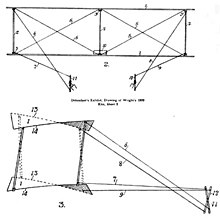
The Wrights now returned permanently to Dayton Ohio.  Although they sent out a brief press announcement in early 1904 to establish their claim, they now retreated into silence to hone their invention. The brothers got permission to use a cow pasture 8 miles outside Dayton, where they assembled the Flyer II and made the first flight on May 23rd.   The 1904 Flyer II was almost a direct copy of the 1903 Flyer, with stronger landing skids and using iron bars to mount the forward elevators in order to move the center of gravity forward.  Progress was slow, the elevators remained over-sensitive in pitch and the brothers remained very cautious, flying low and slow.  They continued to experiment, adding a radiator and circulation system to cool the engine, and then a second radiator.  They changed the vertical rudder, extended the skids, lengthened the propellers and hundreds of minor tweaks and repairs.
The 1904 Flyer II compared with the 1903 Flyer - almost identical

It wasn't until September 15th that the Wrights exceeded 1 minute aloft, and on September 20th, they made their first complete circle of the pasture.  Although the machine remained severely unstable, the Wrights had the skills now to overcome it and make flights lasting several minutes.  From early September onwards, the Wrights used a catapult system to get to flying speed quickly, which greatly accelerated their progress.  Over the course of 1904, the brothers made 105 flights and built up 45 minutes of airtime, culminating in a 4 circle flight on November 9th which covered 3 miles and lasted 5 minutes.  The 1904 Flyer II was not seen by the brothers to be significant breakthrough, and they didn't preserve the machine.

The 1904 Flyer II in flight at Huffman Prarie, low and slow
The 1904 Flyer on November 9th 1904, on the 4 circle flight

On June 23rd 1905, Orville made the first flight of the redesigned 1905 Flyer III.  It was larger with an upgraded engine and bigger 1 gallon fuel tank, but retained the same basic layout and controls.  As a result, its stability remained a problem, and following a major crash in July that wrecked the aircraft (although Orville was unhurt), they decided on major changes.  They doubled the size of the elevator and moved it much further ahead of the wings, while increasing fuel capacity to 3 gallons.  They gave the wings positive dihedral, and disconnected the rudder from the wing warping controls, giving it a separate control handle.  With these changes the rebuilt machine flew on August 24th, and the Wrights found its control and stability to be much improved.  Soon the Wrights were routinely flying figure 8's and circles.  On October 5th, during one of their first public demonstration flights Wilbur flew 24 miles in nearly 40 minutes.  Four days later they wrote to the Secretary of Army, offering the world's first practical airplane.

The 1905 Flyer III as originally built, with short
elevator spars and anhideral wings

The 1905 Flyer III with longer spars and dihideral wings


On November 7th the Wrights disassembled the Flyer III and stored it until 1908, when they prepared for an Army demonstration flight by adding 2 seats and modifying the controls.  They sent it to Kitty Hawk for  testing,where it was wrecked in a crash.  Starting in 1914, the Flyer III was salvaged and restored, and in now on display at Carillon Park in Dayton Ohio.

The World's First Practical Aircraft, September 7th, 1905

Wednesday, October 2, 2013

"Success Assured" - Part 4 of "First to What?"

With the airplane now fairly well understood, the Wrights knew all that they had to do was to add an engine to their existing design.  By 1903, there were many different companies building internal combustion engines for cars, motorcycles and other uses, and the Wrights had always assumed they could purchase what they needed.  In December 1902, fresh from their successful flying in North Carolina, they contacted several of them asking for an engine that could deliver 8 or 9 HP and would weigh less than 180 lbs.  Ten firms responded, but none could deliver such an engine, or would do so for a reasonable price.

Now they turned to one of their employees for help, mechanic Charles Taylor, after deciding to build their own.  With Charles' help and mechanical expertise, they designed and built a small 4-cylinder engine weighing only 179 lbs.  To save weight, they greatly simplified the engine, which lacked sophisticated cooling, carburetor and spark plugs.  The engine was cooled by evaporation of water from a cooling jacket, and would overheat once that water was gone.  Fuel dripped into the inlet manifold from a small 1 qt fuel tank fed by gravity.  Ignition was mechanical driven by a battery (not on the airplane) for starting and a simple magneto to keep it running.  When cold the engine delivered 16 HP, but quickly dropped to 12 HP as it heated up.  It took them 6 weeks from concept to bench tests.

The Wright Brother's Engine, built by Charles Taylor
 The main technological advance that the Wrights were responsible for in 1903 was the propeller design.  Up till then, airplane propellers had been thought of as being like fans, with flat blades, or like screws, with curved blades.  The Wrights believed that propellers were a well understood technology, but as they researched naval design, they found little or no real empirical understanding of how this 100 year old design actually worked.  The two brothers began addressing the problem in their usual style, each arguing from a point of view until they had both convinced each other that the other person was right.  After several months, they hit on the answer that suddenly seemed obvious - a propeller was an airfoil, just like a wing - only one that rotated and moved through the air in a spiral and generated its lift horizontally.

The innovative propeller design and bicycle chain drive
 With that revelation, they could use their tables of airfoil designs and wind tunnel test to build a twisted airfoil shape for their propeller.  They mounted the engine and used bicycle chains connecting sprocket wheels of various sizes to gear the rotation down to the optimal speed for the propeller.  Each propeller was 8.5 feet in diameter, made of spruce, and twisted along its length so that the airfoil met the oncoming air at the best angle of attack.  The Wrights used gear ratio of 23 to 8, so that for every 23 revolutions of the engine, the propellers rotated 8 times.

Now the Wrights designed and engineered their 1903 airplane, knowing their engine power and weight, pilot weight, lift coefficient and target speed - they had all the components needed to calculate the lift, drag weight and trust needed to design their airplane.  They also submitted their first patent application for a "flying machine", which was awarded in 1906, and focused on the 3 axis control.  Using their experience of flying the 1902 glider they developed a padded hip cradle to control the wing warping and inter-connected vertical rudder, and a simple wooden lever that controlled the moveable elevator (still on the front, canard-style).  They mounted an anemometer to measure airspeed, a rev counter to monitor the engine speed, and on-off switches for fuel flow.  In September, the Wrights packed up their Flyer and headed for Kitty Hawk.

The 1903 Flyer's controls - hip cradle for the prone pilot, elevator lever and engine controls

Bad weather delayed their progress as they assembled their machine, a full 700 lbs in weight - twice as heavy as the 1902 glider, 21 ft long and with 40 ft wingspan.  It was massive.  Due to it's size and weight, the airplane couldn't be hand launched like previous designs, so the Wright built a simple 60 ft launching rail after calculating the needed take off run.  Although the brothers experienced issues with the sprocket wheels coming loose and a damaged propeller that had to be sent back to Dayton for repair, on December 14th they were ready.  They flipped a coin to see who would make the first flight (Wilbur won).  Giving full power to engine, the Flyer accelerated down the track, until after 40 ft it suddenly reared skyward, stalled at 15 ft and smashed into the sand damaging the left wing.

Undismayed, the brothers began to repair their aircraft, wrote home "There is now no question of final success",  and in a telegram "Success Assured.  Keep Quiet".  This one statement, "Success Assured", is I think the most telling - they had designed, tested and engineered the airplane - they KNEW it would work.  They were also totally unworried about competitors who were trying their own designs around this time, such as Samuel Langley and Augustus Herring.  They knew their aircraft would work, the others wouldn't.

On December 17th, with the airplane repaired and the weather cooperating, it was Orville's turn.  Forewarned by Wilbur about the overly-sensitive elevator, Orville started his take off run with Wilbur running alongside.
One of the most famous photos ever taken - Orville at the controls, Wilbur running on December 17th, 1903

Tuesday, September 17, 2013

Turning the Corner - Part 3 of "First to What?"

Although initially dispirited after the 1901 gliding season was ended, Wilbur soon recovered his natural optimism.  After only 2 weeks, his sister Katharine commented "We don't hear anything but flying machine and engine from morning till night....."  In September of the next year (1902), Wilbur made a presentation to the Western Society of Engineers, in which he recapped the Wright's experiments to date, and his comments were published in their transcripts, which were highly sought after by fellow experimenters.

Wilbur and Orville had become suspicious of Lilienthal's list tables, which they now thought may be in error, and also wondered if Smeaton's cofficient, used to calculate lift and drag for an airfoil, was also wrong.  At the time, Smeaton's coefficent (k) was thought to be 0.005, but it had also been experimentally measured as being anywhere between 0.0027 and 0.0054, albeit with poor instruments.  The US Weather Bureau had started to use k=0.004 instead.

The first test rig

To test their ideas the Wright's placed a small wheel horizontally on the front of one of their bicycles that balanced the drag from a plate of known size against the lift of an airfoil, but they found speed control difficult.  However, their early results seems to confirm their doubts in both Lilienthal and Smeaton.  So Orville, the most practical of the two brothers, made a small 18" long wind tunnel with a fan to generate airflow and vanes to ensure the flow was turbulence free.  They also created a very innovative way to measure lift and drag, again balancing the unknown force against known drag from flat plates also exposed to the same airflow.  In this way, they could make precise measurements of force, without having to measure force directly with springs and complicated mechanism.


The Wright's larger wind tunnel


In October 1902, Wilbur wrote to Octave Chanute, saying that "Lilienthal's table is very seriously in error".  Armed with this data, and using the results from their 1901 glider, the Wrights had calculated Smeaton's coefficient to be 0.0033, which is within a few percentage points of the value accepted today.  Using the new value for k and a new larger wind tunnel they built in October 1902, the Wright's tested a variety of airfoil shapes.  Although the wind tunnels are lost, the balance mechanism and drag plates are on display at the Smithsonian museum.  With the correct value for k in hand, Wilbur recalculated the proper coefficient of lift (CL) for their airfoil designs, and determined which wing shape was optimal for the speeds they flew.

Now the Wrights could design an airplane and know the critical functions of lift, drag, and glide angle (or power needed) in advance.  They had become the first true aeronautical engineers in the sense that their future designs were engineered for a specific level of performance, not just built in hope they would get off the ground if they were lucky.  They were also fully controllable designs with moveable airfoils, not just weight shifting.

Now the Wrights built a new glider, the 1902 glider - the first engineered aircraft.  They shipped it South to Kill Devil Hills in the September of that year, where Octave Chanute visited and brought, really against the Wright's desires, a few of his designs for "comparative testing".  The Wrights by this time were so far advanced that they already knew those designs were flawed and why they wouldn't fly, but not wishing to hurt the old man they accepted his gliders, but spent as little time as they could with them.

The 1902 glider was the largest aircraft built to that time.  The wings were longer and narrower (high aspect ratio), which they now knew reduced parasitic drag.  The airfoil had a camber of 22:1, and wing area of 305 feet.  It flew marvelously.  The Wrights started flying it a kite, and immediately noticed that it's lift was enough to make the wires almost vertical, rather than at the substantial angle of the 1901 glider.  The wing flew at a substantially lower angle of attack, and generated much less drag, with a glide ratio about 10:1.

The 1901 and 1902 gliders flying as kites (see the difference?)

Wilbur make the first flights, making glides of over 500 ft, and finally Orville took the controls of an airplane for the first time.  In the first 3 days they had flown further than their previous two trips combined.  One control problem remained, the strange "Well Digging" behavior when in a banked turn, named because the low wing would leave a crater in the sand as it dropped and pivoted.

Today we know this as "adverse yaw", a phenomenon caused by the increasing lift on the rising wing, which since drag is proportional to lift, also increases the induced drag for that wing.  As a result, the nose is pulled in the opposite direction to the turn, something we overcome with applying rudder in the direct of a "coordinated turn", one of the first things a student pilot learns (especially in a glider).  At the low speeds the Wrights flew, just above the stall, pulling the rising wing backwards would yaw the glider into a side slip, dropping the low wingtip into the ground.

Wilbur flying the first true airplane - with dual fixed vertical rudders (later replaced with a single moveable one)


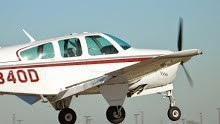
Orville invented the next innovation, a movable vertical stabilizer/rudder.  Wilbur, the more experienced pilot, recognized that with their limited controls of the time, a third control would be too much, and proposed tying the moveable rudder to the wing warping controls, inventing the coupled turn used on many modern aircraft, such as the Beechcraft Bonanza.  Around the same time, the Wrights re-rigged the glider to have drooping wingtips, inventing dihedral wings (although most wings use positive dihedral today, some still use negative dihedral or "anhedral", as did the Wrights).

With control over all three axis, the Wrights never again experienced well digging, and the airplane was substantially invented in 1902.  That year, the Wrights made nearly 1,000 flights, with the longest being 622 ft and lasting 22 seconds.  Enthusiastically, and in great contrast to the previous year, Orville wrote home "We now hold all records!"

Thursday, June 27, 2013

Onward to Kitty Hawk - part 2 of "First to what?"

So far, the quest to fly had been Wilbur Wright's alone.  in the summer of 1900, he engaged some of the rest of his family - Orville, with whom Wilbur designed and built the 1900 glider, and Katharine, who helped sow the fabric for the wing covers.  Katharine doesn't get as much credit as she should, because she didn't go to Kitty Hawk and attend the test flights. And test flying is what they did at Kitty Hawk, for the next 4 autumns.

The Wright's bicycle shop was their source of income - the Wright's built their bicycles in the winter and spring months, so that they had stock to sell in the Ohio summer.  Once the shop was stocked they could use their workshop for other things, such as airplane design.  Once the summer bicycling season was done, they could spend a few months getting away - and flying.

In the Autumn of 1900, Wilbur traveled to for the first time to Kitty Hawk with his glider - their research had suggested that the autumn winds were favorable for test flying there.  Orville followed after Wilbur had set up camp, and Orville had closed the shop.  They initially flew their glider as kite to test out its lifting and wing warping controls.  Due to unavailability of 18 ft lengths of spruce in the area, Wilbur instead used 16 ft length of white pine to make the wing spars, substantially reducing the wing area.

The 1900 glider flying as a kite


The glider flew well despite the shorter wings, and Wilbur began free glides down the sand dunes, mostly short and low to the ground.  They were concerned about avoiding the not-well understood stall phenomenon that had killed Lilienthal, and had determined to control their risk by flying low and using a "canard" design with the fixed elevator  in front.  Pitch control was by weight shifting, but roll was controlled by wing warping.  The Wrights were encouraged by their beginning, and Orville began to become as invested as Wilbur in their project.

The Wrights were wise to fly low - several times the gliders's main wings did stall, but with the canard elevator, instead of a fatal pitch down, the glider just settled to the ground in a flat attitude, leaving both man and structure intact and undamaged.  The wing warping system worked well, and Wilbur was able to make controlled turns - an aviation first.

Feeling that they were making good progress, in the spring of 1901 Orville and Wilbur began designing a new glider - bigger, and with a moveable elevator - the biggest aircraft yet flown and built to their design using all the best data available from Octave Chanute.

The larger, but disappointing 1901 glider


Dan Tate and Orville Wright launch Wilbur in the 1901 glider
The 1901 glider was a disappointment.  The Wrights had used Lilienthal's lift tables and Chanute's suggestion of a 12:1 wing camber instead of the 22:1 camber of their 1900 glider (the camber is the ratio of the wings length from front to back, divided by the height of the wings maximum curvature at its thickest point).  The resulting lift didn't match what the tables said it should - it only generated about 1/3 of their calculated value, and was substantially more draggy, having to fly at an exaggerated pitch up (angle of attack) to generate enough lift to carry a man.  The pitch control was erratic and not fast enough.  They experimented with a smaller control surface, but the problems remained.  Still Wilbur (who did all the flying) was able to get some long glides and built up his level of flying experience - and suffered some serious stalls, fortunately all at low level and slow speed, and the damage to pilot and machine much reduced thanks to their "backwards" design.  The picture above shows Wilbur flying the glider, with Orville and Dan Tate holding the wings.  You can clearly see the greater wing curvature and the moveable forward mounted elevator.  You can also see the open area below Wilbur - allowing him to supplement the elevator pitch control with weight shifting.

The 1901 glider continued to show the value of wing warping, able to make controlled, banked turns most of the time, but showing an odd tendency to sometimes turn the opposite way - pivoting around the raised wingtip. The Wright's left North Carolina discouraged, Wilbur commenting to Orville that men would not fly for fifty years.

Tuesday, June 25, 2013

The First to (what?) - Part 1

Invention is often portrayed in the movies as a "eureka" moment of inspiration, followed by effortless triumph.  In reality, it's a lot more work.  Before developing the incandescent light bulb, Edison tried an unknown number of things, and was quoted saying 'I have not failed. I've just found 10000 ways that won't work.'

The Wright Brothers, Orville and Wilbur, are often described as "the first to fly".  They were not - even if you don't count balloons, quite a few people had lifted off Terra Firma in heavier-than-air machines before December 17, 1903.  Their real achievement was to engineer the first practical and controllable airplane, and then fly it - in 1905.


Sir George Cayley, 6th Baronet of Brompton, didn't himself fly in his glider.  Being a nobleman and memeber of parliament, he had one of his employees fly - his coachman - who promptly resigned, saying that he was employed to drive, not to fly.  The picture below shows a replica flying in 1973, since photography hadn't been invented in 1853.  His main contribution to aeronautics, is that he was the first to identify the four primary forces acting on an aircraft, that we all learn as student pilots - weight, lift, thrust and drag.

File:Cayley Glider Replica Flown By Derek Piggott 2.jpg
A replica of Cayley's 1853 design, flown 120 years later


Otto Lilienthal approached flying in a systematic way, creating a series of gliders that he flew down hills in Germany.  His main contribution was to test a series of airfoil shapes, and develop lift tables.  His gliders used a bar which he held, and used weight shifting for control - just like a modern hang glider.  Unfortunately on 9 August 1896 a sudden wind gust caused his glider to stall, and his weight shifting was insufficient for recovery.  He crashed and died.

File:Otto Lilienthal gliding experiment ppmsca.02546.jpg
Lilienthal flying one his gliders in the late 1890s


Octave Chanute was a French railway engineer who moved to the USA as a child.  He designed many railway bridges and yards throughout the Midwest, but turned as an older man to aviation.  He was too old to fly himself, but engaged Augustus M. Herring and William Avery as substituents.  His primary contribution to design was the biplane glider, reasoning (based on Lilienthal's tables) that more lifting surface was needed, but the scale could be kept under control by decking the wings.  His largest design used 12 wings stacked one on top of the other.  His secondary contribution was to act as a kind of manual bulletin board for the science of aviation, informing all the world's pioneers of the discoveries and activities of others in the field.


File:William Avery Chanute glider 1904.jpg
Augustus Herring preparing to fly a Chanute "double-decker" glider


Enter the Wrights.  In 1899 Wilbur wrote to the Smithsonian Institute and started a voluminous correspondence with Chanute, gathering and learning from all who had gone before him (most competitors didn't take such a systematic approach).  Learning that people knew how to get off the ground, he identified control as the main issue, and had his nearest approach to the "eureka moment" when he conceptualized twisting the Chanute double decker to achieve "wing warping".  He built a glider using wing warping, and flew it as a kite that summer - demonstrating that he could control the kite.  The Wright's most important contribution was also their first.


Wilbur Wright's 1899 glider/kite using wing warping

Wednesday, June 19, 2013

In The Beginning - (Warning, this post make religious statements!)

So it says at the top that this blog will cover several topics, one of which is religion.  I've kind of nibbled around the edges with more philosophical musings, and some thoughts on the philosophical and religious implications of modern science, specifically quantum mechanics. 

This one's different.  I'm going to take on a central tenant of some Christian churches, namely, what is the Word of God?

Without getting into which is which, some denominations state bluntly that the Bible is "The Word Of God", inerrant, the source all dogma and the founding "constitutional" document to which all questions are referred.  A friend recently posted on his Facebook page that the Bible held up well against other similar ancient documents when compared to archeological research, but I think this misses the point.

The claim is that the Bible is the actual verbal or written musings of an omnipresent, omniscient being who transcends space and time.  Yet the Bible is full of things that contradict modern knowledge, scientific and archeological:

  • The 7 Day creation.  If this is true, then a whole lot of science is invalidated, or vice verse.  You can't have both The Bible and evolution be true at the same time, no matter how many impossible things you might believe before breakfast. The only consistent, logical outcome is to believe in one, and dismiss the other as untrue.  Those who reject science in favor of creationism are at least being logical, if misguided.  Personally I prefer to follow the evidence from astrophysics, geology, biology, chemistry at just about every other branch of physical science.  The evidence for evolution and an ancient Earth is overwhelming.
  • The Global Deluge.  Nice story of Noah and his Ark, but there is not geological evidence to support it.  There are similar flood stories in many cultures, which some say shows it likely happened, but I think, given the claim of inerrancy in the source material, (Genesis,) it shows the opposite - a common folk tale told as fact by a writer in antiquity.  Some think the flood tale may be the result of the creation of the Caspian or Black Seas, as sea levels rose and the Mediterranean broke into what were agricultural lowlands in the ancient Fertile Crescent.
  • The Israelite Sojourn in Egypt.  This is the well known story of how Joseph led the Isrealites into Egypt, where they were enslaved by the Pharoahs and forced to build the pyramids, until God caused Moses to lead them into the Promised Land, breaking the Egyptian chains with plagues and parting the Red Sea.  The trouble is, that only the Hebrew Bible tells that story, no other sources (such as Egyptian tablets and scrolls) make mention of the rather dramatic events.  Wouldn't you think the Egyptians would have made some note of such things?  And that prior to Moses, we would find things like slave auction notices and bills of sale, which we do from almost every other slave holding culture?  The genetic evidence shows that the Isrealites were actually Canaanites who developed a separate culture in place, and the Exodus is just a founding myth (that has been extremely effective).
  • Many other tales miracles in the Old Testament.  For example, the tale of a Judge (Samson) whose physical strength was proportional to the length of his hair (a very similar tale spread in dark ages France about the Merovingian kings, who wore their hair long and claimed they could not be beaten in battle - until they were).  The walls of a city (Jericho) falling to the sound of trumpets.  Apologists try to find explanations for all of these, but either they were bona fide miracles (that don't happen today) or they are myth, legend or simply embellished history.
I'm perfectly fine with the idea that the Old Testament/Pentateuch etc are a mixture of myth, legend and real history, as some of it surely is - for example the capture of Isreal by Darius in the great Persian Empire.  Where I diverge is the idea that the Old Testament can be the work of God (as an author), and in particular be the "Word" of God, this omniscient, omnipresent, transcendent being.  How come He didn't get His facts straight?

The New Testament is somewhat different. I'm not going to get much into whether it is historically accurate - in fact it seems to be very accurate indeed, although a couple of straight forward self contradictions are recorded.  For example, how did Judas the Traitor actually die?  Matthew 23:3 says he hung himself in remorse after returning his blood money to the priests and elders.  Acts 1:18 says Judas used the money to buy a field, and there he fell over and his body burst open, and he died.  They can't both be true.    Also, although Mark, Luke and Mathew agree on the basic narrative, they disagree on the order things happened, and when they quote Jesus, the words are not the same.  Not quite an inerrant recording of events, in any case.

So what's my conclusion?  I think the Bible says what it really claims to be: "holy men of God spake as they were moved by the Holy Ghost" (2 Peter 1:21).  And the key part is here, at the beginning of the Gospel of John: "In the Beginning was the Word, and the Word was with God, and the Word was God", followed by "The Word became flesh and dwelt among us".

Isn't it clear that no written thing is the Word of God?  The Bible makes it very clear that it doesn't claim that for itself.  It (or rather, John and Saul/Paul) makes the claim that Jesus = The Word of God, although according to the four gospels, Jesus never called himself that.  He said he was "The Son of Man".  But that's a different topic altogether.


Sunday, June 16, 2013

Illegal Alien - and Ace Fighter Pilot


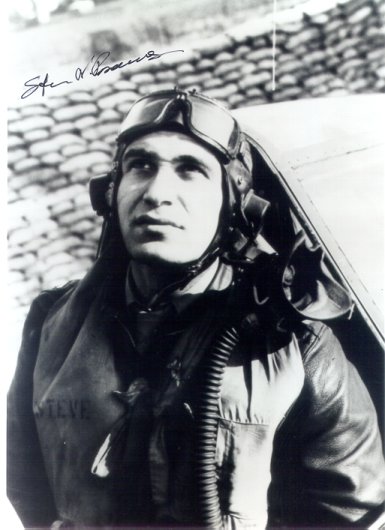
In the movie version of the book, "Forrest Gump", the hero just manages though pure serendipity to be present at almost every great event in the 1960s and 70s.  Spyridon "Steve" Pisanos was in many ways the Forrest Gump of World War 2.  Known then as "Spiro", he was the third child from a family of six, born in late 1919 into a working class family in Athens, Greece.

When he was a boy of twelve he noticed a humming sound, and saw a biplane from the Hellanic Air Force buzzing nearby Kolonos Hill.  Like many of us, from that time on he possessed a burning desire to fly.  But his family had no spare money, so he contented himself with cutting classes and going most days to Tatoi aerodrome, where he would watch the airplanes coming and going.  Eventually that summer, he became braver and found a gap on the fence and walked onto the field.  No-one paid any attention, and on later visits, he befriended some of the mechanics and started doing odd jobs.

Eventually the squadron leader noticed him and discovered he was an interloper.  Kindly, he turned a blind eye, and also counseled him of how to get into the air force - which would cost money his family didn't have and would take better grades that he was getting.  His frequent missing of school eventually caught up with him, and his father told him the facts of life - that flying was dangerous and expensive and he would never be able to do it.  He tried to build his own airplane from broken down car parts, but abandoned the attempt and buckled down to get out of high school.

Realizing that life in Greece wouldn't permit him to follow his dreams he decide to leave, and go to America.  He couldn't afford to buy a ticket, so he joined the merchant navy seaman's union and started working below decks as a fireman on a freighter  His job was to move coal from the bunkers to the boilers, where the stokers would add it to the fires.  His plan was to wait for the ship to visit the USA, and jump ship.

In the Spring of 1938, his ship entered Baltimore harbor.  Early on a Sunday morning, he climbed over the side and bummed a ride from a small boat delivering newspapers.  He only knew 2 words of English - "New" and "York" - where the ex-patriot Greeks lived.  Using this limited knowledge he bought a train ticket and made it to New York.  Leaving the station, one of the first things he saw was a movie theater with a Greek flag - the theater was showing the first Greek-made movie.  Standing outside of it, he heard young male voices speaking Greek.  His two new friends took him under their wings, gave him a place to stay and showed him how to sign up for a job at an employment exchange that was run by a Greek.

Spiro started working as a soda-jerk in a Greek-owned restaurant on 149th and Broadway.  He slowly started teaching himself to read English. Saving his money, that summer he went to Floyd Bennett field and took his first flight, in a Waco biplane.  The Italian instructor told him he needed to speak better English, so he took lessons and eventually started flight training in a J-3 Cub in August 1938.

Money was a challenge, so he changed jobs and moved to Plainfield New Jersey where rent and flying cost less.  He took a job at the Park Hotel in Plainfield, and continued his lessons at Westfield airport.  In February 1941, the INS caught him.  Fortunately for Spiro, by this time Greece had been invaded and was under Nazi occupation, giving him the status of refugee.  Also in his favor - the INS agent was himself a refugee and prior illegal immigrant, from Germany.  Spiro got his green card, and was now a legal immigrant. In July of that year, he got his private license and flew whenever time and money permitted.  He felt like the happiest man on Earth.

A month later, he learned that Royal Air Force was recruiting American pilots to create an "Eagle Squadron" to fight the Germans.  Armed with his brand new FAA license, he presented himself and was accepted.  At that time US citizens who signed up to flight for the British and Canadians risked loosing their citizenship, but Spiro wasn't American.  In November 1941 he was asked to report to a flight school in Glendale CA, where he met the rest of the motley crew.  While he was there, Japan attacked Pearl Harbor and Germany declared war on the US.

In the cold of a 1942 Canadian winter, Spiro and the rest of his squadron reported to the RAF in Montreal to be officially inducted into the British armed forces.  They crossed the Atlantic by ship and started training at RAF Cosford - beginning with how to march and how to salute, and ending with flying the Hawker Hurricane.  In July 1942 Pilot Officer Pisanos was posted to 268 squadron, flying the North American Mustang I (known to the US Army Air Force as the P-51A).

Late in August, the Greek Air Force in exile tried to grab Spiro to fly for them as they reformed their air force flying in North Africa.  In order to short circuit their attempt, Spiro (now "Steve") wrangled a transfer to 71 "Eagle" squadron - one of the three all American squadrons flying Supermarine Spitfires.


The following month, the three Eagle squadrons were transferred into the US Army Air Force, which was disaster for Steve, since only Americans could fly for them.  However, cooler heads prevailed and Steve was made a 2nd Leutenant in the USAAF - and soon afterwards what was now called the 4th Fighter Group traded their Spitfires for P-47 Thunderbolts.  And on May 3rd 1943, the US embassy asked him to attend a special meeting where he was made a US Citizen, the first to be naturalized on foreign soil.  Edward B Murrow of CBS reported on it in his radio broadcast, and the story made the Stars and Stripes newspaper.  Six days later, Steve got his first kill, a German FW-190.

Soon after, Walter Cronkite interviewed Lt. Steve Pisanos, something that Cronkite remembered later because as he was leaving, Steve buzzed Cronkite's car with his P-47 at very low level - his way of saying "Farewell!".

Early in 1944, the 4th Fighter group was re-equipped with P-51B Mustangs. The Rolls Royce Merlin engines gave a lot of problems initially due to defective spark plugs and problems with fuel quality.  In early May 1944 after shooting down his 4 enemy fighters in the same mission (making his score 10 confirmed), Steve's engine failed during his return flight.  He made a successful belly landing between Le Havre and Évreux in German-occupied France.  Evading capture with the help of the French Resistance, he was hidden in Paris awaiting a chance to escape through neutral Spain.  In the meantime, he went on several raids with the Resistance, until on June 4th, the D-Day invasion changed all of his plans.  With the US and Free French armies approaching Paris, the Resistance began daylight fighting with German occupying forces, with Steve Pisanos fighting alongside them.  On August 23rd, the US 4th Infantry Division reached Paris and Steve was liberated, along with some other US airmen with his group.

On his return to the 4th in England, he learned that he couldn't continue to fly combat missions since he knew too much about the Resistance which he might be forced to tell if he was captured.  Promoted to Captain and reassigned to Flight Test at Wright Field, in Dayton Ohio, he first went to Muroc Field (now Edwards Air Force base) in California to attend Test Pilots School (and met the famous Pancho Barnes), flying the first American jets (the P-80) and captured Germany aircraft such as the Me262 jet.  Soon Captain Chuck Yeager and Lt. Bob Hoover joined the flight test team along with Gabby Gabreski, Don Gentile and and Dick Bong - all famous pilots in their own right, either then or later.

In January 1946, Steve left the Air Force to become a pilot with TWA.  Shortly after that, he met his future wife, Sophie Pappas.  They married in June 1946.  The uneven life of an airline co-pilot and frequent furloughs took their toll on his small but growing family, and in October 1948 he rejoined the renamed USAF, again flying as a test pilot on F86 and F-100 aircraft.  As a full Colonel, he served in Vietnam in the late 1960s, but his career came full circle when in 1974 he was assigned to the USAF delegation integrating the McDonnell Phantom II into the Greek Hellanic Air Force squadrons flying out of Tatoi airfield, just outside of Athens - the same airfield where as a boy he had cut classes to stand outside the perimeter fence, wishing to fly.


For more details, see his wikepedia page.  At the time of writing, Colonel Steve Pisanos is 93, and lives in San Diego.  http://en.wikipedia.org/wiki/Steve_Pisanos