Sunday, June 16, 2013

Illegal Alien - and Ace Fighter Pilot


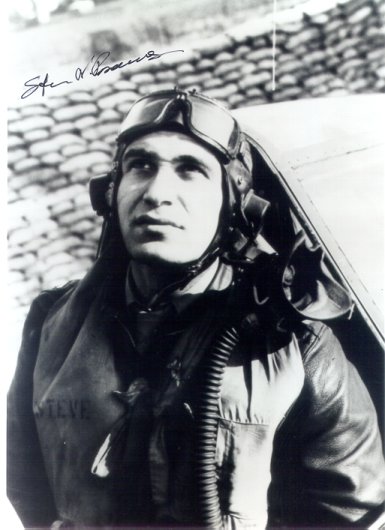
In the movie version of the book, "Forrest Gump", the hero just manages though pure serendipity to be present at almost every great event in the 1960s and 70s.  Spyridon "Steve" Pisanos was in many ways the Forrest Gump of World War 2.  Known then as "Spiro", he was the third child from a family of six, born in late 1919 into a working class family in Athens, Greece.

When he was a boy of twelve he noticed a humming sound, and saw a biplane from the Hellanic Air Force buzzing nearby Kolonos Hill.  Like many of us, from that time on he possessed a burning desire to fly.  But his family had no spare money, so he contented himself with cutting classes and going most days to Tatoi aerodrome, where he would watch the airplanes coming and going.  Eventually that summer, he became braver and found a gap on the fence and walked onto the field.  No-one paid any attention, and on later visits, he befriended some of the mechanics and started doing odd jobs.

Eventually the squadron leader noticed him and discovered he was an interloper.  Kindly, he turned a blind eye, and also counseled him of how to get into the air force - which would cost money his family didn't have and would take better grades that he was getting.  His frequent missing of school eventually caught up with him, and his father told him the facts of life - that flying was dangerous and expensive and he would never be able to do it.  He tried to build his own airplane from broken down car parts, but abandoned the attempt and buckled down to get out of high school.

Realizing that life in Greece wouldn't permit him to follow his dreams he decide to leave, and go to America.  He couldn't afford to buy a ticket, so he joined the merchant navy seaman's union and started working below decks as a fireman on a freighter  His job was to move coal from the bunkers to the boilers, where the stokers would add it to the fires.  His plan was to wait for the ship to visit the USA, and jump ship.

In the Spring of 1938, his ship entered Baltimore harbor.  Early on a Sunday morning, he climbed over the side and bummed a ride from a small boat delivering newspapers.  He only knew 2 words of English - "New" and "York" - where the ex-patriot Greeks lived.  Using this limited knowledge he bought a train ticket and made it to New York.  Leaving the station, one of the first things he saw was a movie theater with a Greek flag - the theater was showing the first Greek-made movie.  Standing outside of it, he heard young male voices speaking Greek.  His two new friends took him under their wings, gave him a place to stay and showed him how to sign up for a job at an employment exchange that was run by a Greek.

Spiro started working as a soda-jerk in a Greek-owned restaurant on 149th and Broadway.  He slowly started teaching himself to read English. Saving his money, that summer he went to Floyd Bennett field and took his first flight, in a Waco biplane.  The Italian instructor told him he needed to speak better English, so he took lessons and eventually started flight training in a J-3 Cub in August 1938.

Money was a challenge, so he changed jobs and moved to Plainfield New Jersey where rent and flying cost less.  He took a job at the Park Hotel in Plainfield, and continued his lessons at Westfield airport.  In February 1941, the INS caught him.  Fortunately for Spiro, by this time Greece had been invaded and was under Nazi occupation, giving him the status of refugee.  Also in his favor - the INS agent was himself a refugee and prior illegal immigrant, from Germany.  Spiro got his green card, and was now a legal immigrant. In July of that year, he got his private license and flew whenever time and money permitted.  He felt like the happiest man on Earth.

A month later, he learned that Royal Air Force was recruiting American pilots to create an "Eagle Squadron" to fight the Germans.  Armed with his brand new FAA license, he presented himself and was accepted.  At that time US citizens who signed up to flight for the British and Canadians risked loosing their citizenship, but Spiro wasn't American.  In November 1941 he was asked to report to a flight school in Glendale CA, where he met the rest of the motley crew.  While he was there, Japan attacked Pearl Harbor and Germany declared war on the US.

In the cold of a 1942 Canadian winter, Spiro and the rest of his squadron reported to the RAF in Montreal to be officially inducted into the British armed forces.  They crossed the Atlantic by ship and started training at RAF Cosford - beginning with how to march and how to salute, and ending with flying the Hawker Hurricane.  In July 1942 Pilot Officer Pisanos was posted to 268 squadron, flying the North American Mustang I (known to the US Army Air Force as the P-51A).

Late in August, the Greek Air Force in exile tried to grab Spiro to fly for them as they reformed their air force flying in North Africa.  In order to short circuit their attempt, Spiro (now "Steve") wrangled a transfer to 71 "Eagle" squadron - one of the three all American squadrons flying Supermarine Spitfires.


The following month, the three Eagle squadrons were transferred into the US Army Air Force, which was disaster for Steve, since only Americans could fly for them.  However, cooler heads prevailed and Steve was made a 2nd Leutenant in the USAAF - and soon afterwards what was now called the 4th Fighter Group traded their Spitfires for P-47 Thunderbolts.  And on May 3rd 1943, the US embassy asked him to attend a special meeting where he was made a US Citizen, the first to be naturalized on foreign soil.  Edward B Murrow of CBS reported on it in his radio broadcast, and the story made the Stars and Stripes newspaper.  Six days later, Steve got his first kill, a German FW-190.

Soon after, Walter Cronkite interviewed Lt. Steve Pisanos, something that Cronkite remembered later because as he was leaving, Steve buzzed Cronkite's car with his P-47 at very low level - his way of saying "Farewell!".

Early in 1944, the 4th Fighter group was re-equipped with P-51B Mustangs. The Rolls Royce Merlin engines gave a lot of problems initially due to defective spark plugs and problems with fuel quality.  In early May 1944 after shooting down his 4 enemy fighters in the same mission (making his score 10 confirmed), Steve's engine failed during his return flight.  He made a successful belly landing between Le Havre and Évreux in German-occupied France.  Evading capture with the help of the French Resistance, he was hidden in Paris awaiting a chance to escape through neutral Spain.  In the meantime, he went on several raids with the Resistance, until on June 4th, the D-Day invasion changed all of his plans.  With the US and Free French armies approaching Paris, the Resistance began daylight fighting with German occupying forces, with Steve Pisanos fighting alongside them.  On August 23rd, the US 4th Infantry Division reached Paris and Steve was liberated, along with some other US airmen with his group.

On his return to the 4th in England, he learned that he couldn't continue to fly combat missions since he knew too much about the Resistance which he might be forced to tell if he was captured.  Promoted to Captain and reassigned to Flight Test at Wright Field, in Dayton Ohio, he first went to Muroc Field (now Edwards Air Force base) in California to attend Test Pilots School (and met the famous Pancho Barnes), flying the first American jets (the P-80) and captured Germany aircraft such as the Me262 jet.  Soon Captain Chuck Yeager and Lt. Bob Hoover joined the flight test team along with Gabby Gabreski, Don Gentile and and Dick Bong - all famous pilots in their own right, either then or later.

In January 1946, Steve left the Air Force to become a pilot with TWA.  Shortly after that, he met his future wife, Sophie Pappas.  They married in June 1946.  The uneven life of an airline co-pilot and frequent furloughs took their toll on his small but growing family, and in October 1948 he rejoined the renamed USAF, again flying as a test pilot on F86 and F-100 aircraft.  As a full Colonel, he served in Vietnam in the late 1960s, but his career came full circle when in 1974 he was assigned to the USAF delegation integrating the McDonnell Phantom II into the Greek Hellanic Air Force squadrons flying out of Tatoi airfield, just outside of Athens - the same airfield where as a boy he had cut classes to stand outside the perimeter fence, wishing to fly.


For more details, see his wikepedia page.  At the time of writing, Colonel Steve Pisanos is 93, and lives in San Diego.  http://en.wikipedia.org/wiki/Steve_Pisanos

Friday, May 31, 2013

D.B. (the first one)


This is the first of what might become a series.    When I was a child, and even today, many of my heroes were pilots.  Since I was born in the late 1950s, pilot stories of my youth were dominated by World War II, which to me seemed ancient history - but with the advantage of experience and histrical context I now realize it had only recently ended and shaped much of the world I grew up in.  In many ways the history of the 20th century can be seen as one long struggle between the rising powers of Russia, Germany, Japan and the USA, with the declining powers France and the British and Ottoman Empires, starting in 1870 with the newly unified Germany defeating France, and not ending until the fall of the Soviet Union and collapse of the Warsaw Pact in 1989 and 1990.

I spent my childhood and got my education in England, and have spent nearly all my adult years in America.  Initially my flying heroes flew for the RAF and RCAF, and only later did I learn much about America's flying heroes Dick Bong, Hub Zemke and others.  By the way, for my American readers, did you know Charles Lindbergh was the 27th person to fly across the Atlantic?  He wasn't even the first to do it non-stop?  He just had better PR.  Later still I learned about Luftwaffe aces Macky Steinhoff, Adolf Galland and Eric Hartmann, and Japanese aces like Subaro Sakai.  It took years to realize that they weren't necessarily better men, or even better pilots - they were better warriors.

So I'm going to introduce you to a British ace who was a better pilot, and a great leader and fighter.  As a man he had his flaws, but sometime history rises to meet the person and shows his or her greatness.  British and Canadians know him, but most Americans do not.

Douglas Bader was born in 1910 in England, although his parents, like many of the time, lived in India, where they returned almost immediately after his birth, leaving him with relatives.  Only after two years did he rejoin his mother and father in India.  Shortly before World War 1, the family returned to England, and soon afterwards Douglas' father was wounded in the trenches and later died.  His mother re-married to a church of England clergyman, and Douglas was sent off to boarding school.  There he neglected his studies, but became a well regarded sportsman, playing Cricket, Boxing and Rugby with fervor.

When it came time to leave, he determined to join the Royal Air Force (RAF) as cadet at Cranwell, the RAF officer training school.  He had to take extra lessons to pass all the academic criteria, but succeeded and won a full scholarship.  At Cranwell he learned to fly and to pass the technical ground school, and again excelled at sports - stubborn, arrogant and cocky, he was selected for fighters and was posted to 23 squadron in 1930, flying Gloster Gamecocks - a slow but agile biplane little different from World War I fighters like the Sopwith Camel.

In those days squadrons were also training schools, and his flying training continued - and Bader excelled at that too.  By the next year he was selected to fly in the RAF's precision flying display at the Hendon Air Day - a precourser to the Red Arrows formation flying displays at Farnborough.  He was also selected to play cricket and to box for the RAF teams, and to play rugby on the England national team.  Before that game could take place however, his cockiness and unwillingness to back down from challenge caught up with him.  Challenged to do low level aerobatics at Woodley Aerodrome near Reading England, he initially declined, and when accused of being "windy" he angrily took up the challenge and crashed performing a low level roll.

The wreck pushed the rudder pedals through his lower legs.  At Reading hospital, both legs were amputated - one above the knee and one below.  When ready, he was fitted with two artificial legs - but stubbornly he refused to walk with a cane.  The RAF sent him to Central Flying School to see if he could still fly, which he succeeded at brilliantly, despite having no feeling in his (artificial) legs.  Because the RAF had no regulation permitting a legless man to fly, he was re-assigned to ground duties, and finally left the service with a pension, 100% disabled.

Bader got a job in the City of London working for Shell Oil, in their aviation fuels office. While recovering from his accident, he had met his future wife Thelma, and they married.  His competitive drive undimmed, he took up golf (and became good enough to play in pro-am tournaments) and unbelievably, squash - a game played with racquets and a bouncy ball in a small room, very similar to racquetball.  In 1938, the RAF started rapid expansion, and Bader got confirmation that they would take him back if war made it necessary - he started praying for war with Germany.  It came on September 3rd, 1939.

Bader rejoined the RAF and was sent to flying school, and passed rated as "exceptional".  He passed his medical, but retained his disability pension - officially 100% fit and 100% disabled - at the same time.  He was posted to 19 squadron as a very elderly Pilot Officer (2nd Lieutenant), flying Mark 1 Spitfires.  He was rapidly promoted to Flying Officer, and was sent to 222 squadron as flight commander, also flying Spitfires, just in time to cover the British Armies evacuation at Dunkirk.  There he shot down his first aircraft, a bf109 and probably shot down a Heinkel 111.  Or probably not - over-claiming was rampant in the RAF, especially over enemy held territory.  The RAF over-claimed about 3 to 1, about the same at the US Army Air Corp fighter pilots. 

File:Douglas Bader.jpg


RAF 242, a Hurricane squadron was withdrawn from France soon after, and its Canadian pilots lacked a squadron leader, the last being killed in France.  Placed in 12 Group it needed a strong leader, and Bader was transferred as acting Squadron Leader (Major).  The role of 12 Group was to guard the English industrial midlands from air attack, and to back up 11 group in the south.  Flying alone in bad weather, Bader soon shot down a Dornier 17 bomber off the coast of East Anglia.  Finally, in August 1940, 242 squadron was thrown into the Battle of Britain, asked to cover the North London sector.
 The squadron did well - the experienced Canadian pilots experience and skill worked together with the calm, confident leadership of Bader to become extremely effective, and Bader was given operational command over first three, then five squadrons, which he operated as the "12 Group Big Wing".  12 Group had the luxury of time to gather a big wing, being further from the French coast, while 11 Group operated their squadrons singly, or in pairs.  Even so, 12 Group was often late arriving, hitting the bombers after they had bombed their targets.  Since many of these targets were 11 Group airfields, some bad feeling arose between the group leaders, Leigh-Mallory of 12 Group and Park of 11 Group.  The 12 Group fighters way over-claimed, but being hit by up to 60 British fighters at once demoralized the German pilots.  Finally Hitler ordered the Luftwaffe to attack London, bringing the bulk of the fighting within range of Bader's squadrons, who feasted on the often unescorted medium bombers.

By the end of October, the Battle of Britain was winding down, and the Chief of Fighter Command, Sir Hugh Dowding, retired. Leigh-Mallory was chosen to replace Keith Park as head of 11 Group, and he brought Bader with him.  Douglas was promoted to Wing Commander (Colonel), and given command of the three squadrons based at Tangmere, on the South coast.  In the spring of 1941, the RAF began offensive operations, the daylight bombing of occupied French facilities and airfields near the coast (the RAF was also night bombing Germany, rather ineffectually).  The Tangmere wing was called on to escort them, and to perform fighter sweeps over Northern France.

At this point, Bader introduced his most important innovation, the "Finger Four" formation.  It was derived from a German formation, but was modified for the British way of operating.  The Finger Four was flexible, suited for both offensive and defensive maneuvering. This formation replaced the line astern and 3-plane "vic" formations used by the RAF before, and was later adopted by the US Air Force and used all way into the Vietnam era, before being replaced by the "loose deuce" and "fighting wing" 2-plane formations used today.

Tired and overdue for a rest, in August 1941 Bader allowed himself to become separated from the rest of his wing, and was shot down (he always claimed a Messerschmidt 109 collided with him, but the evidence is that he was shot down, possibly by one of his own pilots).  One of his legs got stuck inside his Spitfire, and he bailed out with only one leg attached.  The Germans placed him in a hospital under guard, and the RAF dropped him a spare leg.  Mobile again, he escaped by climbing down knotted bed sheets from his 3rd floor window, but was recaptured the next morning, and sent to Germany and a POW camp.

He became an incorrigible annoyance to the German guards, baiting them and attempting to escape several more times.  He was transferred frequently, and narrowly avoided being part of the the "Great Escape", in which 50 POWs were murdered by the Gestapo.  With his record, he would likely have been one of those killed.  Finally, in exasperation, he was sent to "Colditz", an escape proof prison in a castle in a hill.  Several more escape attempts failed, and eventually he and his co-prisoners were freed by the US Army in 1945.

Returned to England, he was promoted to Group Captain, commanded the RAF's tactics school, and flew the first jets.  But the thrill of combat was gone, and Shell Oil recruited him back with the offer of a Vice President's title and his own private aircraft (his last one was a Beechcraft Bonanza).  He flew all over the world in his airplane, was knighted by the new Queen, and played golf against the very best.  In 1982, Sir Douglas Bader died after speaking at a dinner in the London Guildhall (where I had just received my bachelors degree in aeronautical engineering 17 months earlier, before moving permanently to the USA).  For more details, see the Wikipedia page here: http://en.wikipedia.org/wiki/Douglas_Bader.

Bader was immortalized by Paul Brickhill in his book "Reach for the Sky".  As a teenager I read that book over and over.  I liked the flying parts the best, but now, having found a copy on Amazon, I am more taken with how brave, determined and stubborn he was, and how that was both an aid (he used them to learn how to walk on his "tin legs") and a hindrance (he refused to admit it if he was wrong).  The book became a movie starring British actor Kenneth Moore, and Bader himself authored a book on World War 2 fighter tactics, called "Fight For the Sky" (in my collection).

I also have a poster depicting his Spitfire Mk 5a and a bf-109F in combat in the spring on 1941, signed by Bader himself and his great war time enemy and post-war friend, General Adolf Galland.  It is hanging in the front hall.  I saw him once, from a great distance, at an airshow in Nottinghamshire.  But I recall being more interested in the Spitfire and Hurricane aircraft parked near him - I was 15.

By the way, my English Springer Spaniel is named Douglas - after this man.

Monday, May 6, 2013

Trip Planning

There's a big spring conference coming up in two weeks in Las Vegas.  I've attended nearly every one for the past 18 years (I missed 2000 because I was living in England at the time).  This is "Wireless 2013", put on by the Cellular Telecommunications Industry Association, or CTIA.  Insiders usually refer to it at "CTIA", not by its official name.

CTIA 2013™ Logo

Normally I go representing my employer, to put on an exhibit, meet with customers, or speak in a "track", a series of presentations about some burning topic of the moment. Since I'm currently unemployed, I'll be representing myself, using my network to help find that next opportunity, and using my airplane to get there and back on my schedule and my terms.

From North Dallas to Las Vegas is slightly over 1,000nm direct, taking a few minutes more than 6 hours at 162 kts average ground speed.  But I won't be doing that for several reasons.  My V-tailed Bonanza holds 80 gallons in 2 tanks, 40 in each wing, but 6 gallons are unusuable and shouldn't be counted on, and I need to leave at least 30 minutes (VFR) or 45 minutes plus time to an alternate (IFR).  I normally plan on 1 hour reserve fuel at 15 gallons an hour, meaning I have 18 gallons unusable for planning purposes.  I can only plan on burning 62 gallons, or slightly over 4 hours before I have to refuel.

I'm getting older and need more of what are euphemistically known as "comfort stops".  My bladder range is between 2 and 3 hours, 2 being comfortable and 3 not. I've tried using various implements to take care of this in the air, but for some deep psychological reason it doesn't work for me.  So since I have to stop anyway, I generally try to plan legs at about 2.25 to 2.75 hrs with 3 hours being the maximum.  I fill up with fuel at each stop, so as one tank empties, the others are filling.  I'm never weight limited in the Bonanza, the limit to how much I can carry is usually based on the rear CG limit.  I can carry my wife Sally, Thing 1 and Thing 2 in the back, full fuel and about 80 lbs in the rear baggage compartment, leaving some 300 lbs of gross weight capability unavailable.

The service ceiling for the V35A Bonanza, according to the POH (Pilot's Operating Handbook) is 17,000 ft.  My real world operating ceiling, since I don't carry oxygen, is 14,000 ft for 30 minutes duration, or 12,500 ft indefinitely, in accordance with FAR part 91.211. I could carry an oxygen bottle with a cannula (that leaky tube they put under your nose in a hospital) to use the full range of altitudes, but the airplane performance goes down substantially after 12,000 ft, and I don't think it's worth the extra expense and complexity.  If I had a turbocharged or supercharged engine that could provide full power into the high teens and 20's, that would be different.  A straight line direct route from Dallas to Las Vegas would go over some pretty high terrain, with mountains over 10,000 feet.  My route will avoid anything over 8,000 feet.

Taking all of this into account, I'm choosing a route over El Paso and Phoenix.  It will add about 30 minutes, but the direct route, if I could fly high enough, would be in stronger headwinds, so the penalty isn't too bad at all.  I can expect better winds lower down.  

First leg: T31 (AeroCountry) direct to KPEQ (Pecos TX), 2 hours and 34 minutes, plus a few minutes of vectoring by DFW Approach.  Pecos has reasonably priced fuel, and the direct route doesn't go through any restricted airspace.

Second leg: KPEQ to E60 (Eloy Municipal), 2 hours and 55 minutes.  That's the long leg, and will go via the El Paso (EWM), Deming (DMN) and San Simon (SSO) VORs.  The reason for that route is that it avoids the military operations areas (MOAs) and most of the high ground, passing over Bassett Peak (7,660 feet MSL), the highest point of the the whole route.

Third Leg: E60 to Henderson, NV (KHND), 1 hour 40 minutes.  This leg needs some planning.  I'm thinking of going via the PXR (Phoenix) VOR, the MAIER intersection and Drake (DRK) VOR, because a route directly over the main airport would be least disruptive to the constant airline traffic approaching PHX from the East or West, especially if I can be up at 8 to 10,000 feet before South Mountain, a point commonly used by aircraft on a visual approach to Skyharbor.  It is relatively direct, with two nearly 7,000 ft peaks along the way.  There is a more direct route over low ground, but it has several MOAs along the way, and no planned airways - unlike the route I selected.  I doubt I would get ATC approval.

Altogether, this route avoids the highest mountains, has stops reasonably spaced, with good fuel availability, and covers 1,060 nm, only 50 more than direct.  And I get to fly my own airplane!

Friday, April 5, 2013

A Tale of Two Airports

It was the best of times, it was the worst of times - that's how Charles Dickens started his story about the French Revolution, through the eyes of his protagonists living at different ends of the social spectrum, and in two very different cities and societies.  Viewed through the lens of aviation, the city of McKinney is itself two very different places......

On the East side of McKinney, Texas, is Collin County Regional Airport.  If you follow the airport signs from US-75 (Central Expressway) East along Eldorado, you will arrive at the base of the new control tower, opened in 2012.  The airport is owned by the city, and operated by the Collin County Airport Development Corporation (CCADC), which "is tasked with promoting, developing, encouraging and maintaining aeronautical facilities, commerce and development at Collin County Regional Airport". The City council appoints seven board members.

Although the Automated Weather Observation System (AWOS) which broadcasts on 119.925 MHz always announces "Collin County Regional Airport" before giving the most recent weather measurements to pilots (you can hear it on your phone by dialing (972) 548-8525), the aviation world simply calls it "McKinney", or knows it by its International Civil Aviation Organization code "KTKI".  All US airports with an ICAO code start with the letter "K", Dallas-Fort-Worth's code is KDFW.

McKinney Tower manages all aircaft traffic within 4 nautical miles of the tower, and up to 2,500 above ground level (AGL), which at KTKI is 588.9 feet above sea level, according to the FAA.  So the KTKI airspace is a cylinder, centered on the airport and 8 nautical miles in diameter, and up to 3,100 ft MSL (above mean-sea-level).  From 4,000 MSL to 11,000 feet MSL, the airspace above McKinney belongs to DFW Regional Approach, leaving a small sliver from 3,100 to 4,000 open to all comers.  But in practice pilots commonly talk to the tower anywhere from about 8 to 10 miles away, and certainly while overflying unless talking to DFW Approach

McKinney airport recently opened a new, wider, and stronger runway, called runway 18-36, which refers to the compass heading of the runway, depending on which way an airplane is facing.  Taking off or landing to the North, the compass will read "360", and to the South, "180".  Drop the trailing "0"s and you get the runway designation.  All airports around the world use that method.  Taxiways Alpha and Bravo run parallel to the runway (Bravo used to be the old runway), under the control of the "McKinney Ground" controller, leading to the North and South Hangars, and the FBO, which stands for "Fixed Base Operator".

Bigger airports usually have an FBO, and some airports like Dallas' Love Field have several.  The FBO is like an airport terminal for private airplanes, and combines the functions of security, check in, parking (for aircraft and cars), car rental, and gas station (for airplanes).  The lone FBO at McKinney is Cutter, part of a chain of FBOs in mostly in the southwest.  The Cutter offices also house a flight school and pilot shop, run by Monarch Aviation, and manages hangar space for the airport.  The two largest hangars by the FBO are used by maintenance shops, Air-O Specialists of Texas, which does most regular maintenance work on large and small aircraft, and Select Avionics, which sells and maintains the aircraft electronics (known as "avionics")

McKinney airport is a busy, corporate place.  It caters mostly to private business aircraft, which generate the most income, but the majority of the actual traffic is single engine propeller aircraft. At any given time, about half the aircraft in the pattern are doing some form of training, American Flyers and Monarch, based at Addison like to use Mckinney airport for repeated take off and landing practice (known as "touch-and-goes") since it's banned at even busier Addison.  The other half are either visiting aircraft, or aircraft based on the field.  There are a couple of flying clubs, the biggest being the North Texas Flying Club, which started out as the Texas Instruments flying club, but opened its membership to all in the 1990s.  For about $400/mo, aircraft owners can lease a private single airplane "T" hangar, or they can share a larger one with other airplanes, for less money.  Private Jets need their own hangars, some company flight departments might have an even larger hangar if they have multiple airplanes.

The Collin County Regional Airport Board has ambitions about eventually bringing scheduled commercial airliner flights into KTKI.  The new runway meets the international standards for passenger aircraft up to 450,000 lbs, good enough for regional jets and some small airliners, for all current business aircraft (except for a very few privately owned 747 and A380 aircraft, mostly in the middle east, and for Air Force One.)

If Collin County Regional Airport if the business face of Mckinney Aviation, AeroCountry is the smudgy-faced hobbyist country cousin.  Located 8 miles West of KTKI, between US-380 and Virginia Parkway just West of Custer Road, AeroCountry is a small, privately owned airport - but it's not all low rent.  The West side of the runway is a mixture of "T" hangars and shared hangars, together with about half a dozen houses with attached hangars for those pilots who can't bear to leave their flyable babies alone, even for a night.  The East side is all new development, with large shared hangars, and combination condominiums with attached hangars and a swimming pool.

There's only one jet on the field, an ex-Romanian Air Force trainer, parked at the south end.  There are many old and new biplanes, some homebuilt, and eclectic mix of everything else - twins, singles, open cockpit, closed cockpit, pushers, world war 2 trainers.  Some of these are transient, since there are several small maintenance shops on the field, but there is no FBO.  Pilot's can pump their own fuel from a tank near the south end, for about $1/gallon less than McKinney airport, but that's it.  There is no pampering at AeroCounty.

AeroCountry has an FAA designator, T31, but no ICAO designation.  Despite some publications (and GPS Navigation units) calling it "KT31", that's wrong.  It's just T31.  It has a single runway, 17-35, at 792 feet MSL.  Unlike McKinney, AeroCountry has no bad weather instrument approaches - if weather conditions are less than Visual Flight Rules (VFR), the field is essentially closed to landing traffic.  Although you can take off from T31 into rain and clouds on an instrument flight plan, there is no way to get back to the ground at T31.  The runway is long, at 4,000 feet, but the north 1,000 feet is grass, leaving about 3,000 feet for most aircraft.  Some of the biplanes and WW2 trainers like to land on the grass part of the runway.

The runway was very narrow and a bit broken up, but as part of the deal with the condo developer on the East side, the airport received a new, wider runway in 2011.  There is a main road called AeroCountry Road leading into the airport, and small roads off it that double as taxiways.  You have to be careful driving at T31 - the traffic coming around the blind corner might be an airplane.  The small roads are all named after aviation legends, starting with Aeronica, Bucker, Champion and Decathlon, and going in alphabetical order to Yak Drive at the far North end.  Boeing, Airbus and Lockheed Martin don't get roads at T31, but small plane pilots know all these names.  I keep my own airplane on Bucker, named for a German light aircraft manufacturer pre-war.  Personally I think it should be renamed "Beechcraft", but that's only because I fly one.  Mooney gets a road, but Cessna and Piper don't.  Whoever chose these names went for aviation obscurity.

The airport is owned and run by the property owners on the field - own a hangar and you get a vote.  There are some non-aviation businesses that rent hangars, for old car restoration, storage and so on, and a cheer-leading school off the main entrance road.  Some cheerleader Moms have been known to get confused and drive onto the runway by mistake - this is aviation as it was before 9/11.  The pilots know each other and know who should be where, so interlopers are quickly seen and redirected.  Because the runway is small and bounded by trees on the East and Hangars on the west, the board doesn't allow touch and goes at AeroCountry, unless the aircraft is based on the field.  There is a flying school that teaches tailwheel flying and does aerobatic instruction, but that's it.  AeroCountry is an airport for experienced pilots who own their own aircraft.

It's unusual for a city of 140,000 to have two airports, even the City of Dallas itself only has two - Love Field and Redbird Executive.  Plano has one (Plano Airpark), as do Addison, Denton and Mesquite.  Carrollton, Frisco, Richardson and Garland have none.  Encroaching development is threatening both airports, which now have noise abatement procedures that pilots try and adhere to, when it is safe to do so.  AeroCountry has the bigger problem with houses now immediately to the East and South - not too long ago it was surrounded only by horses and cattle.  Pilots like to say that the airport was there first, but in a democracy the majority rules.  As baby boomers and WW2 veterans age, and the price of fuel continues to climb, the number of active pilots and airworthy aircraft is declining, but McKinney has two treasures that should both be nurtured and preserved, even though the face each presents to the world is quite different from the other.

All copyrights retained.

Friday, March 22, 2013

Where Is Everybody?

Modern astronomy is finding new planets at an astounding rate - several hundreds in the past decade.  It's becoming clear that solar systems are commonplace, at least in this galaxy.  Most stars that can have planets, do have planets.  Our ability to find these extra-solar planets is still limited, we can't identify small, rocky planets orbiting at the right distance to support our type of life.  But in our own solar system, 3 of the 8 planets (omitting dwarf planets like Pluto and Ceres) orbit in the habitable zone - Venus, Earth, and Mars.  That's roughly 1 in 4 of an admittedly small sample size.

Venus may have had life, but it has a runaway greenhouse atmosphere of carbon dioxide and nitric acid, with surface temperatures hot enough to melt lead.  Some have proposed to inject blue-green algae into the air, which would metabolize the CO2 into oxygen and water, dropping the temperature and making it rain for the first time.  After some period of time, Venus might become habitable for us.

Mars is too small to keep it's atmosphere, which has mostly all escaped into space.  All that remains is a thin, sparse covering of carbon dioxide, but water once ran freely on the surface, and may still be there, frozen at the poles and under the Martian soil.  Mars may have hosted life at one time, but not intelligent life - there are no canals, and no ruined cities.

Earth is the Goldilocks planet - neither too hot, not too cold.  Once it too was covered in a reducing atmosphere, but anaerobic life evolved, and turned the sky oxygen-blue, while comets deposited oceans of water.  Oxygen breathing life evolved, became multicellular and eventually what passes for intelligent (the US Congress not withstanding).  What is the likelihood this is unique?

Intelligence itself doesn't appear to be unique - chimps, dolphins and elephants seem to have at least some self-awareness, and creatures such as octopi, crows and apes can use tools and solve puzzles.  Our sample of one suggests that life eventually gives way to intelligent tool users.  So far it looks like planets are common, and life may be too.

So if the universe is full of planets teeming with intelligent tool users - where are they?  The Sun (Sol) is a very common type of G class yellow dwarf, a third generation star that has shone for 5 billion years.  The universe is about 13 billion years old - while it took some time to make the heavier elements we need, such as iron, silicon and carbon, there has been plenty on time for civilizations to arise before ours.  If star travel is possible, why have they not been here?  Why are they not here now?  We certainly will be out among the stars as soon as we get the technology down - that's our way.

The fundamental problem is that the Universe is too old, and too big.  Our galazy, the Milky Way, is one of hundreds of billions or even trillions of galaxies, and holds around 200 billion stars - that's 30 stars for every man, woman and child alive today.  In this galaxy alone.  Anything that can happen, has happened - somewhere.  If star-travelling species can exist, they do exist.  And if they do exist, why did they not colonize our solar system already?

There are a few possibilities, none of them very pleasant:

  1. Life, and especially tool using intelligent life is actually very rare.  Maybe we are unique - or civilizations are so spread out as to almost never make contact with each other.  What evidence we have so far is rather against this.
  2. Technology is a fatal disease - all civilizations that develop it die, from pollution, nuclear holocaust, or self made pathogens.  None make it as far as communication with other civilizations, or to star travel.
  3. Star travel isn't possible, and the planet-bound civilizations either don't communicate with each other, or they don't use radio.  Perhaps we are too young to have developed sub-space based communications which are instantaneous and efficient, and they are watching our TV signals and shaking their heads (or whatever they shake) over our youthful stupidity.  And poor production values.
  4. Everyone is hunkered down, or dead.  Advanced machine civilizations silently cruise the interstellar starways, and when they capture the radio signals from an ignorant and wasteful emerging biological infestation, they send out the clean up crew.
There is one other possibility - we are the first ones, a unique creation.  Perhaps created by God, perhaps by ourselves we are creating the universe as we go.  I wrote about this a few years ago http://dbcooper-theblog.blogspot.com/2009/05/changing-past.html.  Perhaps the universe is collapsing out of the probability  foam as we go about our daily lives, never noticing what we are doing to the quantum universe around us.

“You are gods; you are all children of The Highest!" - The Bible, Psalm 82 vs 6.

At least that one's hopeful......

Wednesday, March 20, 2013

Passing It Along - A Different "It"

Recently I've had some extra time on my hands, thanks to the general economy, and market conditions in my industry - network equipment for wireless mobile operators.  The North American giants of 10 years ago (Nortel, Motorola and Lucent) are all gone - swallowed by European companies like Ericsson and Alcatel, or replaced by Asian competitors like Samsung and Huawei.  My career has been focused on the delivery to market of products, but increasingly those products come from offshore.  So while I'm optimistic, it's taking a while to find a new job.

So I've been playing with Family Tree Maker, a piece of genealogy software that aggregates public records online, and allows you to use other people's research to build your family tree is no time.  And this is what I found.

My side come from a long time of farm workers in Yorkshire, and further back, Lincolnshire, England.  My Father's line for 5 or 6 generations is all local to that area, on the Yorkshire coast near Scarborough.  My Mother's line goes back through a great grandfather to the South of England, London and Sussex.  Both lines peter out eventually.

My Wife's side is much more interesting:

Line 1 - The Harts.  On December 27 1657, Edward Hart, along with 3 others signed a document sent to Peter Stuyvesant, the last Dutch Governor of New Netherland (now New York), protesting the lack of religious freedom.  For this, they were jailed until they repented.  Edward Hart was eventually released due to illness, and the document became known as the Flushing Remonstrance, the first declaration of religious freedom in the New World.  Edward Hart's descendants moved to New Jersey, where his great grandson, John Hart, became one of the New Jersey colony's representatives to the Continental Congress, and signed the Declaration of Independence on July 4th, 1776.

His daughter Deborah married Joseph Ott in 1786, their daughter Sarah married Matthias Servis, and eventually the Servis's married into the Conovers, a Dutch immigrant family (originally spelled Van Kouwenhoven). Sally's Mother's side are Conovers, plus Mennings, a line originally traced back to Transylvannia, in what is now Romania.

Line 2 - The Norsemen.  In 911, a Viking nobleman of Danish or Norwegian origin called Rollo Rognvaldsson (http://en.wikipedia.org/wiki/Rollo) besieged Paris, and on 20 July 911 he lost the Battle of Chartres to the Duke of Burgundy.  Rollo then pledged allegiance to the King of France, became a Christian and changed his name to Robert.  In return, King Charles made him Duke of Normandy, which Robert proceeded to pacify and unify under his control.  Until Robert, Normandy was only nominally under the French King's control, after years of Viking invasions, so the King gave him a title, and a task.

Robert I was the first of six powerful Dukes of Normandy, the sixth being William, who is known to history as William The Conqueror, the first Norman King of England.  Robert and his sons and daughters married into the noble families of France and the Holy Roman Empire, merging their Norse bloodline with the descendants of Charlemargne (Charles The Great) and Clovis I (the founder of the Merovingian Dynasty).

 The 5th Duke of Normandy, Robert II Curthose, sired a bastard son, Gilbert FitzRobert (in those days, a bastard was given their father's name, with the prefix "Fitz" in front. Thus "FitzRobert" means the child on Robert, and FitzRoy means "son of the King" (Roi)).  FitzRobert's chldren eventually come to England with their Uncle, William the Conqueror, and became Lords and Ladies of the English Norman court.  After a few hundred years, and after descent through the De Somery line of Welsh Norman Lords, and later the Huddingtons, one Joan Huddington married Sir Roger Wyntour.  Her 4th great grandson, John Winter, emigrated to the American colonies, dying in Charles MD in 1715.    The Winters married into the Emplfields, and later the Palmers (originally Balmer, from Germany), moving to Pennsylvania along the way.  Finally the Palmers married into an Irish line called the Wachobs, ending when a Wacob married my wife's Grandfather on her Father's side.  So from that side she has English, Viking and French royalty, plus descent from the greatest Holy Roman Emperor, Charlemagne.  I also found 3 saints, two more revolutionary war solidiers and a lot of "Fitz-somethings" along the way.

So while my side is pulling itself up from our British farm peasant roots, her side is a long descent from the top of the heap.

Sunday, March 17, 2013

Passing It Along

I flew almost every day this week. It's spring break in Texas, and my kids have been home.  My oldest daughter, Thing 1,  is a senior and for a class project she chose "learning to fly".  For many people, that would have been ambitious, but her case, since her dad is an instructor and aircraft owner, it was the "choice of least resistance".  Her boyfriend by way of comparison (a Nation Honor Society Finalist and holder of multiple offers from colleges for "free-rides"), is learning to play the school song on every instrument in the band, and mashing the recording together so that he is playing the whole thing - solo.

I felt that my Bonanza was a bit much for a beginner, so I borrowed a friend's Sundowner for the occasion.  Normally, if I'm teaching a student to get ready for a sport pilot or private pilot license, I'll spend more time in the air doing basic maneuvering, stalls, ground reference and gliding before moving to the airport pattern, but in this case her goal is to be able to fly a complete pattern including the landing in a short time.  I think this is a good thing - when I fly with my family I would like for there to be someone else on board who could get the thing on the ground, in at least a survivable crash-landing.  Thing 1 might fit the bill.

So we started with climbs and descents, level turns, moderately steep turns and simple stall recovery.  Next we moved to an airport and started doing pattern work.  After nearly 1 week, she can now do the full power take off, crosswind climb (with a bit erratic speed control, but within private limits), come back to downwind power (2,000 rpm) and turn onto a 1,000 foot AGL downwind holding 80 kts,  set up for landing (GUMPS, electric fuel pump on, lower flaps, set approach power at 1,700 rpm), do the base leg and turn onto final approach adding more flaps and controlling the descent with pitch and power.  I still have to get on the controls at about 100 feet to help with the flare and touchdown.

My friend's Sundowner is hangared in an awkward spot, and since I want Thing 1 eventually to be able to land my Bonanza, I switched her to the Bonanza on Thursday, but as it does everything 10 to 20 knots faster, and has more to remember - she was overwhelmed.  We're going back to the Sundowner.  But now the weather is changing, the winds are no longer light and aligned with the runway.  They are strong and gusty with a significant cross-wind component.  We'll take it up again next week after school.