Showing posts with label Sundowner. Show all posts

Monday, May 9, 2011

Tale of 3 flights

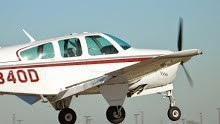
Flight 1 - reprise of the the disaster flight before.  I went back to American Flyers, but deliberately picked a different instructor ( the same one that I did the first flight with).  We flew the same Cessna 172, and did more or less the same routine - GPS 17 at McKinney, followed by the VOR/DME (partial panel), then the ILS 17.  It was somewhat better, but not much.  At that point I decided to jump through the hoops and get my Sundowner approved for instruction in at that school (mostly an inspection by their A&P and some insurance riders).  I think flying in an airplane I know well will take away some of the workload.

Flight 2 - Saturday afternoon, we got the Rocket out the hangar, and with Instructor Anne in the right seat and my Mom in the back, we did a tour of the local NE Dallas airports.  I wanted to practice short field techniques in the Bonanza, as I am going to rent a hangar at AeroCountry, which has a 3000 foot runway - not really short, unless you have been spoiled by a 7000 foot runway for the past several years.  I found the Bonanza to be honest in a slow approach and really fast to slow down if you flare properly.  It still wants almost 2000 feet to take off, however.  It was a blustery day, 20 kts gusting to 35, which the Bo handled with with a disdainful glance.  What a machine!  Only 1.7 more dual hours until I can solo.

Flight 3, today, Monday late afternoon - Flew my "for sale" Sundowner 49C to Addison, and met the American Flyers instructor (I will call her Evelyn).  She grilled me on the "Fundamentals of Instruction", at which I truly suck.  The trouble is they are all just somebodies opinion, written by a professor on a grant, reviewed by a panel of lawyers, blessed by the FAA bureaucracy,  and we poor applicants are made to memorize them word for bloody word like they are gospel truth.  Still, it's a problem I must surmount eventually, or not become a CFI.  The flying went much. much better, despite 25 kts of wind gusting to 45.  I flew in my own airplane, for which I know the V-speeds and the power setting for any given flight domain.  My hold was poor, and my steep turns not so good, but it's still strange to be sitting in the right seat and try to read the instruments from there.  Still, I managed 4 good approaches, and to teach while doing it.  Evelyn says I just need to do a good set of steep turns under the hood and do some good holds (at the CFI level they are never SIMPLE holds....), memorize the FOI's, and she'll sign me off next week..........

Monday, April 4, 2011

For Sale: 1982 Model Beechcraft C23 Sundowner

N6349C is one of the best equipped Sundowners out there.  Serial Number M-2371 is one of the last Sundowners made, and was used for many years as an instrument trainer by Executive Beechcraft in Missouri, and equipped for the job.  I purchased the aircraft in 2005 with a very low time engine, and used it for my own instrument training and to carry my growing 4 person family around the United States.  The only reason I’m selling now, is that they kept on growing, and I’ve upgraded to a V35A Bonanza.


Originally equipped with all round steam gauges, I upgraded N6349C in 2008 to have full IFR GPS capability, coupled to an STEC-50 autopilot with attitude hold.  Combined with dual LOC/GS ILS, KX-165 Nav/Comm radio, ADF, DME and a WX-8 Stormscope, this is a serious IFR cross country machine.  There are next to no instrument procedures you can’t do. 

For pictures: See this blog, or request a spec sheet in your comment with the pictures in it.  Cover included.  

Also in 2008 I added the Power Flow STC for a tuned exhaust, adding 200 to 300 ft/min to my climb rate, and top speed is now in the 130kt range.  With full fuel and 1 person, moderate temperatures and starting at 600 ft MSL, an initial climb of 800 - 1,000 ft/min is not uncommon (well above book).  I normally cruise at 2500 and 115kts TAS, burning 10.5 gall/hr.  The tail weight makes landing significantly easier than most C23’s, and I have rarely had CG issues (I had to add 50lbs of water ballast to the baggage compartment with my 300lb+ DE for my instrument check ride, but that’s it!)


Specs & Equipment:

5500 TT on Airframe
466 hrs SMOH on refurbished 0-360-A4K 180HP 4-cylinder engine S/N L24864-36A. 
466 hrs on Propeller (Senseich 76EM8S5-O-60 s/n 29392K)
Power Flow Tuned Exhaust STC July 2008 (for extra climb power)
Garmin 430 IFR panel mounted GPS (Nav #1), WAAS (430W) upgrade negotiable.
King KX-165 Nav/com radio (with flip flop buttons) (Nav #2)
STEC-50 autopilot with altitude hold, coupled to GPS and the KX-165 (switchable)
King DME remoted to Nav 1 or 2
Collins 4096 Transponder
Collins ADF
Collins audio panel with ILS marker beacon lights
2 place intercom
WX-8 Stormscope
Lights for IFR night ops (standard navigation, plus taxi and landing lights, strobes)
Tail weight STC P/N169-440005-207 installed 1997 (improves landing and keeps CG away from forward limits)
Bruce Aircraft cover and engine inlet plugs

External Paint – good (7), repainted in 1997
Internal Condition – good (8)
Never based near any ocean

Comments:

Annual October 2010 – no major squawks
New tires and ELT battery September 2010
Good compression on all 4 cylinders
No metal in oil
IFR certification August 2009
AD’s complied with
Based at McKinney, TX (near Dallas)
My A&P is well known Beechcraft expert, active on Beech Talk

Asking $59,795.27

Thursday, January 8, 2009

A Very Nice Day

In the cool dense air over North Central Texas, my Beechcraft Sundowner climbs like a rocket. I’m light on fuel, with three empty seats. Opposite a farm house where I’m normally about 700ft above the ground level (AGL), I turn left onto the crosswind leg, and before I can level the wings heading 90 degrees, I’m at 1700 ft above Mean Sea Level (MSL), the pattern altitude at TKI.

Turning left again, heading North over a gravel pit, I ask for and receive clearance for a series of touch and go’s. The tower warns of bird activity east of the airport, but I don’t see them. Opposite the approach end, 1,000 ft AGL, about 1.5 miles to the side, I reduce power to 1500 RPM, and lower a notch of flaps. The nose comes down, and I set up a 500ft per minute descent. I do my short pre-landing check list – mixture full rich, correct tank selected, electric fuel pump on.

Left again, this time heading west, about a mile off the approach end of runway 17, I look back along the straight in approach. The tower cleared me “number 1”, so it’s supposed to be clear, but I still look anyway. It’s a good habit, because not all airports are “controlled” by a tower. Most are uncontrolled, and rely on all pilots to communicate their position with blind radio calls. But not all pilots are conscientious, some forget, and some fly airplanes without radios. So I always look.

One more left turn to align with the extended centerline, heading directly towards the approach end at 75 kts and 500 feet AGL. The VASI lights on the left side show I’m high – one red light and 3 white ones. Sundowners glide like a rock, so I prefer to be high. I add another notch of flaps to increase my descent. Once I have 2 reds and 2 whites, I know I’m on the glide path, and pull back on the yoke a bit to reduce my descent and drop a little speed.

Over the end of the runway – a perfect 50 feet up, 70 kts and slowing. I can’t believe I haven’t flown for almost 2 months! Just above the runway, pull the nose up, but not too far – the slightest hint of a ballooning action and I stop pulling – settle, settle, pull some more – and the main wheels touch without a bounce and just a little “squeak”. Best one I’ve done this year! First one I’ve done this year!

Flaps up, full power, flying speed already – we do to “go” part of a touch and go. Climbing, I follow the same procedure. The goal is to do it the same way every time, no variance, make it habit. Now there’s a Diamond DA20 (2 seat trainer) in the pattern with me. He’s fast, but not quite as fast as me. I have to spread out my pattern a little to stay in sync. I do another Touch, another Go.

This time I deliberately delay my crosswind turn, staying straight until I reach the magic 1700 ft. I’m planning to change things up. On the downwind, opposite the tower, I see the Diamond is about to touch down. “Sundowner xxx with a request”.

“”Go ahead” says the tower. “Yeah, I’d like to make this a power off precision landing, if able” I say, trying to be polite,, but clear with my request. “Cleared for close in approach, cleared to land number 2”.

The Power Off Precision Approach is a commercial maneuver you have to demonstrate as part of the commercial FAA License. It involves pulling the engine power all the way to idle opposite your chose landing spot, and carefully controlling your turns and rate of descent to touch down within 100ft of the pre-designated spot. I’ve done power off approaches before, but this is the first one I’ve tried as a precision approach. Before I started working on mastering the commercial maneuvers, it was good enough just to land on the runway. Now I’m trying to land on a dime, without the use of an engine.

It works. I find I need to delay turning towards the runway for about 1000ft, then make my base leg, followed by turn onto approach. 1 notch of flaps on the base leg, and add more as needed on final. I do this twice, and each time touched down on the white touchdown zone stripe I chose as my target. This stripe is 1000ft from the runway end on all ILS-equipped runways – knowing that helps me judge on the downwind distances.

Finally, I left the now busier airspace around McKinney, and flew east over Lake Lavon about 15 miles while climbing to 3500 ft for some airwork. I’m practicing chandelles, another commercial maneuver. It involved flying straight and level at cruise power, then adding full power while turning and climbing at the same time. To goal is to end up facing the opposite way with the maximum altitude gain – presumably to avoid some obstacle, but also to show how well you as the pilot can control the aircraft through a radical change in pitch, speed and climb.

With 3 chandelles done, it’s time to land. I head back to the field, making a call 10 miles out over the 380 bridge. Just as I prepare to call, I hear: “McKinney Tower, Cessna xxx, 10 miles east, inbound for landing”. Oops. That’s right were I am. I rapidly look all around, and chime in with “McKinney Tower, Sundowner xxx is also 10 miles east inbound, 2000ft over the bridge, with the numbers”. He didn’t give his altitude. I gave mine, along with the fact that I already had all the weather data (the “numbers”) and my exact position.

“Cessna xx, Mckinney, ident”. With that command, McKinney is asking the Cessna to press a button on his panel that causes his “target indicator” as they call the radar return to “blossom” so he can tell who is where. “Sundowner xxx, expect left base approach runway 17.” “Roger xxx”.

I start my base leg about 4 miles away. I’ve found the Cessna, off to my left, no factor. “Sundowner xxx, cleared to land runway 17. Will this be a full stop?” “Affirmative, Sundowner xxx, cleared to land”

“McKinney tower, Sundowner xxx is cleared to land, by the way I found your birds, 700Ft AGL just north east of the approach end runway 17”. “Thank you Sundowner xxx. Taxi to parking, have a nice day”

A very nice day.

Wednesday, January 7, 2009

High Speed Taxi

“Clear!” The words rang across the tarmac at TKI. As the engine caught, I positioned the throttle for 1500 RPMs to warm up the engine on a chilly day, and finished the rest of the “Starting Engine” check list.

Starter disengaged? Check. Oil pressure? Rising into the green. Turn off electric pump – pressure steady on the engine driven mechanical pump. Turn on the Avionics and radios.
“Collin County Automated weather. 22 57 Zulu. Temperature 8, dewpoint -2. winds 180 at 5. Sky clear, visibility 10. Altimeter 30.31. Contact ground on 121.8, advise on initial contact you have India”

It’s Sunday morning. Despite the previous post, I’m not in church, I am flying my Beechcraft Sundowner, a low wing 4 seater with one 180 HP engine on the front.

After contacting ground, I’m cleared to taxi using taxiway Alpha to the end of runway 17 (the number refers to the magnetic heading of the runway, in this case 176 degrees. Pilots are taught to check that the heading on their compass before taking off agrees with the number of the runway assigned to prevent taking off on the wrong runway. The Delta Commuter pilots in Kentucky a few years ago obviously skipped that part).

On the run up – check the controls are free and my own add-on line item – visually check that they move the right way and both gas caps are on. Increase engine RPM to 2200, and turn off the magnetos sequentially and then add carburetor heat, and make sure that in each case the engine drops less than 50 RPMs. Turn off the alternator and make sure that the ammeter goes negative, then turn it back on, and ensure it goes positive. Back to idle, and turn on the radar transponder, make sure I have the right fuel tank selected, fuel mixture is full rich, and electric fuel pump is on. Tune to the tower and call “Sundowner xxx is ready on runway 17, I just had some engine work done, request high speed taxi then return to the end for take off”.
I had some work done on the starter motor. It shouldn’t have affected anything else, but I’m cautious when someone other than me was doing anything to the main component that allows my airplane to go up when I pull on the stick.

“Sundowner xxx cleared high speed taxi runway 17”. I lined up, added full power, but didn’t pull back at flying speed. The sundowner skipped across the bumps, clearing wanting to go up, but I pulled the throttle lever back to idle, and let the aircraft slow down. I pulled off the runway, and called for taxi clearance back to the departure end.

Back at the end, I called for take off clearance,, and asked for some touch and go’s, which were approved. Lined up, and this time at flying speed (65kts) I pulled us off the ground, let the speed climb to 75kts and climbed out at almost 1000 ft/min.

Seems good……