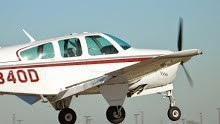
Today is a double G&T day, just a "not-very-good" day of flying.
Marginal VFR. Well, it was. Now I'm in front of my keyboard, the sun is shining through a light haze on it's way to Western horizon. This afternoon, a burst of sun got me on my way to the airport for a few touch and goes just to keep my hand in. When I actually got there, the clouds had rolled back in. ATIS reported 1400 feet ceilings and 5 miles visibility. Not so good, but good enough for a little pattern work.
Pre-flight checks complete, I lined up at the runway, only to be scolded by the controller. It seems I TOLD him that I was going to stay in the pattern for some touch and goes, and he said I should have REQUESTED that I would stay in the pattern. I wrote that off as him having a bad day - normally he is very cooperative and easy to work with. A short silence, then "Roger 49C", and I received take off clearance.
After 4 or 5 circuits, I lined up on final approach with a sense of disquiet. Touching down, I realized that I hadn't heard a radio clearance to land. Glancing at the tower, I saw a solid red light - but I was already in take off mode and quite busy, it didn't register what that meant until I was airborne and realized my radios had failed.
As I climbed out, I pulled out the headset plugs and reinserted them, keyed the radio and heard the transmit static. I called the tower "McKinney Tower, 49 Charlie". "49 Charlie, McKinney Tower. Welcome back". "49C had radio problems, how do you read?". "Loud and clear 49C. You have 2 choices, you can land now or depart my airspace."
I decided to land, and told him so. He told me on final approach that if I wished I could fix my radios on the ground and then take off again, which I did. Once on the ground he had a conversation about what had happened. He told me he had called me several times. I told him I'd seen the red light but too late, he said he'd given me a green light (OK to Land - which I hadn't seen), then the red one (DO NOT TAKE OFF) on the runway, but I had seen it too late.
My problem fixed, I taxied back to the runway, and requested (this time) to remain in the pattern for some touch and goes. On climb out, I suggested that we could both use practice at no-radio procedures, and did a few circuits using the lights (called light guns), backed up by radio calls. I found the green hard to see from more than 3 miles way, but the red was clear as long as I was looking and expecting it. I did another 4 or 5 and called it a day, and the controller seemed to recover his normal personality.
Still, while the actual control over the aircraft was fine, my procedures need work. My first radio failure, and what did I do? I probably didn't land without clearance, but I did take off without clearance at least once. How long did it take until I noticed the Sound of Silence? Did I do it once, or twice?
Either way, Just Not Good Enough.
Showing posts with label flying. Show all posts
Showing posts with label flying. Show all posts
Monday, January 17, 2011

Thursday, August 5, 2010
Turn hard right, mind the trees (and the hill)
Time to leave Gaston's.
Where I normally fly from, McKinney airport in Texas, we have a 7,000 foot concrete runway with no building or trees within 1/2 a mile of either end of the runway. I have room to take off and land 3 times on the runway without turning, and I'm at 500 feet or more before crossing over an obstacle. So the departure from Gaston's was a new experience.
We loaded up the airplane with all four of us, plus luggage and the fish. With 30 gallons of fuel in the wings, the Sundowner was just under it's maximum gross take off weight, and within the center of gravity limits ( I know because I had previously run the numbers). I did a careful check of the airplane and engine, and taxied to the end of the runway as far back as I could get. 3,000 feet on dry, short grass is plenty, but nothing is less valuable than runway behind you.
Running up to full power, with 15 degrees of flaps and brakes hard on, I checked I was getting full RPMs and let her roll. It seemed to take a long time to get the airspeed needle alive, but finally we had 60 kts and I eased Charlie into the air. I stayed low in ground effect to let the speed build up until I had 75kts (best climb speed), and reached for the sky.
Best climb with full gross weight was not going to clear that trees covered hill, so I started a long curve to the right, intending to get into a downwind position where I could land back on the field if anything went wrong as soon as possible. Did I say that I'm not used to trees? Or hills? It was a perfectly normal take off if you are used to such things, but I felt crowded. Simulating a short field, max climb take off and doing one for real are not the same experience at all. But they are the same to actually execute the movements and configuration, so all was well.
Continuing the climb on the downwind, I immediately felt better - I knew I could S-turn onto the grass if I had to glide in; I was visualizing the maneuver in my head. Non-pilots would probably be surprised at how much we think about emergencies and "what I would do now if the engine quit", but this is actually normal. Both guys in the front of your airliner are doing the same thing - only they have more procedures. They calculate how much runway they need to accelerate to takeoff speed and then emergency stop - and based on that they call out V1 and V2 airspeeds on the take off run - V1 means you have to go - there isn't room to stop. I do the same, only for me I make the decision to fly just before using 50% of the runway. And yes, I have abandoned takeoffs if something wasn't right at that point. But not this day.
Thing 2 wanted to fly over the dam, so having more than 1,000 feet at this point, I left the field and flew over the dam, then turned on course. Fuel was too pricey at Gaston's, and I was already near max weight, so I had checked fuel prices on www.100LL.com, and selected Mt. Ida as my fueling stop.
Mt. Ida was just over an hours flying time away. Fuel there was $3.85 a gallon, instead of over $5 at Gaston's, and nearer to $6 at my home airport. It also has a 4,000 foot concrete runway, and was right where I was planning to turn to avoid the Hog MOA (Military Operation Area). It was a Sunday, so I was sure the MOA was not active, but I don't like the high ground and lack of airports under it, so I determined to go around, expending the extra 10 minutes of so for additional safety margin (there we go again....).
After partially replenishing the fuel ( I couldn't just fill up like in a car - that would have made the airplane too heavy with all of us and our luggage), I took off from Mt. Ida heading west. Once again it became clear that I couldn't get over the ridges with our heavy load on a straight climb out, so I made a right turn and did a spiraling climb over the airport. Thing 1 thought we were like a big hawk looking for a large mouse!
Once above the ridges, I turned on course. The air was becoming bumpy in the hot afternoon air, so I climbed (slowly) above the clouds to 8,500 feet where it was smooth, and slaved the autopilot to the GPS, pointing straight home.
Where I normally fly from, McKinney airport in Texas, we have a 7,000 foot concrete runway with no building or trees within 1/2 a mile of either end of the runway. I have room to take off and land 3 times on the runway without turning, and I'm at 500 feet or more before crossing over an obstacle. So the departure from Gaston's was a new experience.
We loaded up the airplane with all four of us, plus luggage and the fish. With 30 gallons of fuel in the wings, the Sundowner was just under it's maximum gross take off weight, and within the center of gravity limits ( I know because I had previously run the numbers). I did a careful check of the airplane and engine, and taxied to the end of the runway as far back as I could get. 3,000 feet on dry, short grass is plenty, but nothing is less valuable than runway behind you.
Running up to full power, with 15 degrees of flaps and brakes hard on, I checked I was getting full RPMs and let her roll. It seemed to take a long time to get the airspeed needle alive, but finally we had 60 kts and I eased Charlie into the air. I stayed low in ground effect to let the speed build up until I had 75kts (best climb speed), and reached for the sky.
Best climb with full gross weight was not going to clear that trees covered hill, so I started a long curve to the right, intending to get into a downwind position where I could land back on the field if anything went wrong as soon as possible. Did I say that I'm not used to trees? Or hills? It was a perfectly normal take off if you are used to such things, but I felt crowded. Simulating a short field, max climb take off and doing one for real are not the same experience at all. But they are the same to actually execute the movements and configuration, so all was well.
Continuing the climb on the downwind, I immediately felt better - I knew I could S-turn onto the grass if I had to glide in; I was visualizing the maneuver in my head. Non-pilots would probably be surprised at how much we think about emergencies and "what I would do now if the engine quit", but this is actually normal. Both guys in the front of your airliner are doing the same thing - only they have more procedures. They calculate how much runway they need to accelerate to takeoff speed and then emergency stop - and based on that they call out V1 and V2 airspeeds on the take off run - V1 means you have to go - there isn't room to stop. I do the same, only for me I make the decision to fly just before using 50% of the runway. And yes, I have abandoned takeoffs if something wasn't right at that point. But not this day.
Thing 2 wanted to fly over the dam, so having more than 1,000 feet at this point, I left the field and flew over the dam, then turned on course. Fuel was too pricey at Gaston's, and I was already near max weight, so I had checked fuel prices on www.100LL.com, and selected Mt. Ida as my fueling stop.
Mt. Ida was just over an hours flying time away. Fuel there was $3.85 a gallon, instead of over $5 at Gaston's, and nearer to $6 at my home airport. It also has a 4,000 foot concrete runway, and was right where I was planning to turn to avoid the Hog MOA (Military Operation Area). It was a Sunday, so I was sure the MOA was not active, but I don't like the high ground and lack of airports under it, so I determined to go around, expending the extra 10 minutes of so for additional safety margin (there we go again....).
After partially replenishing the fuel ( I couldn't just fill up like in a car - that would have made the airplane too heavy with all of us and our luggage), I took off from Mt. Ida heading west. Once again it became clear that I couldn't get over the ridges with our heavy load on a straight climb out, so I made a right turn and did a spiraling climb over the airport. Thing 1 thought we were like a big hawk looking for a large mouse!
Once above the ridges, I turned on course. The air was becoming bumpy in the hot afternoon air, so I climbed (slowly) above the clouds to 8,500 feet where it was smooth, and slaved the autopilot to the GPS, pointing straight home.
Thursday, January 8, 2009
A Very Nice Day
In the cool dense air over North Central Texas, my Beechcraft Sundowner climbs like a rocket. I’m light on fuel, with three empty seats. Opposite a farm house where I’m normally about 700ft above the ground level (AGL), I turn left onto the crosswind leg, and before I can level the wings heading 90 degrees, I’m at 1700 ft above Mean Sea Level (MSL), the pattern altitude at TKI.
Turning left again, heading North over a gravel pit, I ask for and receive clearance for a series of touch and go’s. The tower warns of bird activity east of the airport, but I don’t see them. Opposite the approach end, 1,000 ft AGL, about 1.5 miles to the side, I reduce power to 1500 RPM, and lower a notch of flaps. The nose comes down, and I set up a 500ft per minute descent. I do my short pre-landing check list – mixture full rich, correct tank selected, electric fuel pump on.
Left again, this time heading west, about a mile off the approach end of runway 17, I look back along the straight in approach. The tower cleared me “number 1”, so it’s supposed to be clear, but I still look anyway. It’s a good habit, because not all airports are “controlled” by a tower. Most are uncontrolled, and rely on all pilots to communicate their position with blind radio calls. But not all pilots are conscientious, some forget, and some fly airplanes without radios. So I always look.
One more left turn to align with the extended centerline, heading directly towards the approach end at 75 kts and 500 feet AGL. The VASI lights on the left side show I’m high – one red light and 3 white ones. Sundowners glide like a rock, so I prefer to be high. I add another notch of flaps to increase my descent. Once I have 2 reds and 2 whites, I know I’m on the glide path, and pull back on the yoke a bit to reduce my descent and drop a little speed.
Over the end of the runway – a perfect 50 feet up, 70 kts and slowing. I can’t believe I haven’t flown for almost 2 months! Just above the runway, pull the nose up, but not too far – the slightest hint of a ballooning action and I stop pulling – settle, settle, pull some more – and the main wheels touch without a bounce and just a little “squeak”. Best one I’ve done this year! First one I’ve done this year!
Flaps up, full power, flying speed already – we do to “go” part of a touch and go. Climbing, I follow the same procedure. The goal is to do it the same way every time, no variance, make it habit. Now there’s a Diamond DA20 (2 seat trainer) in the pattern with me. He’s fast, but not quite as fast as me. I have to spread out my pattern a little to stay in sync. I do another Touch, another Go.
This time I deliberately delay my crosswind turn, staying straight until I reach the magic 1700 ft. I’m planning to change things up. On the downwind, opposite the tower, I see the Diamond is about to touch down. “Sundowner xxx with a request”.
“”Go ahead” says the tower. “Yeah, I’d like to make this a power off precision landing, if able” I say, trying to be polite,, but clear with my request. “Cleared for close in approach, cleared to land number 2”.
The Power Off Precision Approach is a commercial maneuver you have to demonstrate as part of the commercial FAA License. It involves pulling the engine power all the way to idle opposite your chose landing spot, and carefully controlling your turns and rate of descent to touch down within 100ft of the pre-designated spot. I’ve done power off approaches before, but this is the first one I’ve tried as a precision approach. Before I started working on mastering the commercial maneuvers, it was good enough just to land on the runway. Now I’m trying to land on a dime, without the use of an engine.
It works. I find I need to delay turning towards the runway for about 1000ft, then make my base leg, followed by turn onto approach. 1 notch of flaps on the base leg, and add more as needed on final. I do this twice, and each time touched down on the white touchdown zone stripe I chose as my target. This stripe is 1000ft from the runway end on all ILS-equipped runways – knowing that helps me judge on the downwind distances.
Finally, I left the now busier airspace around McKinney, and flew east over Lake Lavon about 15 miles while climbing to 3500 ft for some airwork. I’m practicing chandelles, another commercial maneuver. It involved flying straight and level at cruise power, then adding full power while turning and climbing at the same time. To goal is to end up facing the opposite way with the maximum altitude gain – presumably to avoid some obstacle, but also to show how well you as the pilot can control the aircraft through a radical change in pitch, speed and climb.
With 3 chandelles done, it’s time to land. I head back to the field, making a call 10 miles out over the 380 bridge. Just as I prepare to call, I hear: “McKinney Tower, Cessna xxx, 10 miles east, inbound for landing”. Oops. That’s right were I am. I rapidly look all around, and chime in with “McKinney Tower, Sundowner xxx is also 10 miles east inbound, 2000ft over the bridge, with the numbers”. He didn’t give his altitude. I gave mine, along with the fact that I already had all the weather data (the “numbers”) and my exact position.
“Cessna xx, Mckinney, ident”. With that command, McKinney is asking the Cessna to press a button on his panel that causes his “target indicator” as they call the radar return to “blossom” so he can tell who is where. “Sundowner xxx, expect left base approach runway 17.” “Roger xxx”.
I start my base leg about 4 miles away. I’ve found the Cessna, off to my left, no factor. “Sundowner xxx, cleared to land runway 17. Will this be a full stop?” “Affirmative, Sundowner xxx, cleared to land”
“McKinney tower, Sundowner xxx is cleared to land, by the way I found your birds, 700Ft AGL just north east of the approach end runway 17”. “Thank you Sundowner xxx. Taxi to parking, have a nice day”
A very nice day.
Turning left again, heading North over a gravel pit, I ask for and receive clearance for a series of touch and go’s. The tower warns of bird activity east of the airport, but I don’t see them. Opposite the approach end, 1,000 ft AGL, about 1.5 miles to the side, I reduce power to 1500 RPM, and lower a notch of flaps. The nose comes down, and I set up a 500ft per minute descent. I do my short pre-landing check list – mixture full rich, correct tank selected, electric fuel pump on.
Left again, this time heading west, about a mile off the approach end of runway 17, I look back along the straight in approach. The tower cleared me “number 1”, so it’s supposed to be clear, but I still look anyway. It’s a good habit, because not all airports are “controlled” by a tower. Most are uncontrolled, and rely on all pilots to communicate their position with blind radio calls. But not all pilots are conscientious, some forget, and some fly airplanes without radios. So I always look.
One more left turn to align with the extended centerline, heading directly towards the approach end at 75 kts and 500 feet AGL. The VASI lights on the left side show I’m high – one red light and 3 white ones. Sundowners glide like a rock, so I prefer to be high. I add another notch of flaps to increase my descent. Once I have 2 reds and 2 whites, I know I’m on the glide path, and pull back on the yoke a bit to reduce my descent and drop a little speed.
Over the end of the runway – a perfect 50 feet up, 70 kts and slowing. I can’t believe I haven’t flown for almost 2 months! Just above the runway, pull the nose up, but not too far – the slightest hint of a ballooning action and I stop pulling – settle, settle, pull some more – and the main wheels touch without a bounce and just a little “squeak”. Best one I’ve done this year! First one I’ve done this year!
Flaps up, full power, flying speed already – we do to “go” part of a touch and go. Climbing, I follow the same procedure. The goal is to do it the same way every time, no variance, make it habit. Now there’s a Diamond DA20 (2 seat trainer) in the pattern with me. He’s fast, but not quite as fast as me. I have to spread out my pattern a little to stay in sync. I do another Touch, another Go.
This time I deliberately delay my crosswind turn, staying straight until I reach the magic 1700 ft. I’m planning to change things up. On the downwind, opposite the tower, I see the Diamond is about to touch down. “Sundowner xxx with a request”.
“”Go ahead” says the tower. “Yeah, I’d like to make this a power off precision landing, if able” I say, trying to be polite,, but clear with my request. “Cleared for close in approach, cleared to land number 2”.
The Power Off Precision Approach is a commercial maneuver you have to demonstrate as part of the commercial FAA License. It involves pulling the engine power all the way to idle opposite your chose landing spot, and carefully controlling your turns and rate of descent to touch down within 100ft of the pre-designated spot. I’ve done power off approaches before, but this is the first one I’ve tried as a precision approach. Before I started working on mastering the commercial maneuvers, it was good enough just to land on the runway. Now I’m trying to land on a dime, without the use of an engine.
It works. I find I need to delay turning towards the runway for about 1000ft, then make my base leg, followed by turn onto approach. 1 notch of flaps on the base leg, and add more as needed on final. I do this twice, and each time touched down on the white touchdown zone stripe I chose as my target. This stripe is 1000ft from the runway end on all ILS-equipped runways – knowing that helps me judge on the downwind distances.
Finally, I left the now busier airspace around McKinney, and flew east over Lake Lavon about 15 miles while climbing to 3500 ft for some airwork. I’m practicing chandelles, another commercial maneuver. It involved flying straight and level at cruise power, then adding full power while turning and climbing at the same time. To goal is to end up facing the opposite way with the maximum altitude gain – presumably to avoid some obstacle, but also to show how well you as the pilot can control the aircraft through a radical change in pitch, speed and climb.
With 3 chandelles done, it’s time to land. I head back to the field, making a call 10 miles out over the 380 bridge. Just as I prepare to call, I hear: “McKinney Tower, Cessna xxx, 10 miles east, inbound for landing”. Oops. That’s right were I am. I rapidly look all around, and chime in with “McKinney Tower, Sundowner xxx is also 10 miles east inbound, 2000ft over the bridge, with the numbers”. He didn’t give his altitude. I gave mine, along with the fact that I already had all the weather data (the “numbers”) and my exact position.
“Cessna xx, Mckinney, ident”. With that command, McKinney is asking the Cessna to press a button on his panel that causes his “target indicator” as they call the radar return to “blossom” so he can tell who is where. “Sundowner xxx, expect left base approach runway 17.” “Roger xxx”.
I start my base leg about 4 miles away. I’ve found the Cessna, off to my left, no factor. “Sundowner xxx, cleared to land runway 17. Will this be a full stop?” “Affirmative, Sundowner xxx, cleared to land”
“McKinney tower, Sundowner xxx is cleared to land, by the way I found your birds, 700Ft AGL just north east of the approach end runway 17”. “Thank you Sundowner xxx. Taxi to parking, have a nice day”
A very nice day.
Wednesday, January 7, 2009
High Speed Taxi
“Clear!” The words rang across the tarmac at TKI. As the engine caught, I positioned the throttle for 1500 RPMs to warm up the engine on a chilly day, and finished the rest of the “Starting Engine” check list.
Starter disengaged? Check. Oil pressure? Rising into the green. Turn off electric pump – pressure steady on the engine driven mechanical pump. Turn on the Avionics and radios.
“Collin County Automated weather. 22 57 Zulu. Temperature 8, dewpoint -2. winds 180 at 5. Sky clear, visibility 10. Altimeter 30.31. Contact ground on 121.8, advise on initial contact you have India”
It’s Sunday morning. Despite the previous post, I’m not in church, I am flying my Beechcraft Sundowner, a low wing 4 seater with one 180 HP engine on the front.
After contacting ground, I’m cleared to taxi using taxiway Alpha to the end of runway 17 (the number refers to the magnetic heading of the runway, in this case 176 degrees. Pilots are taught to check that the heading on their compass before taking off agrees with the number of the runway assigned to prevent taking off on the wrong runway. The Delta Commuter pilots in Kentucky a few years ago obviously skipped that part).
On the run up – check the controls are free and my own add-on line item – visually check that they move the right way and both gas caps are on. Increase engine RPM to 2200, and turn off the magnetos sequentially and then add carburetor heat, and make sure that in each case the engine drops less than 50 RPMs. Turn off the alternator and make sure that the ammeter goes negative, then turn it back on, and ensure it goes positive. Back to idle, and turn on the radar transponder, make sure I have the right fuel tank selected, fuel mixture is full rich, and electric fuel pump is on. Tune to the tower and call “Sundowner xxx is ready on runway 17, I just had some engine work done, request high speed taxi then return to the end for take off”.
I had some work done on the starter motor. It shouldn’t have affected anything else, but I’m cautious when someone other than me was doing anything to the main component that allows my airplane to go up when I pull on the stick.
“Sundowner xxx cleared high speed taxi runway 17”. I lined up, added full power, but didn’t pull back at flying speed. The sundowner skipped across the bumps, clearing wanting to go up, but I pulled the throttle lever back to idle, and let the aircraft slow down. I pulled off the runway, and called for taxi clearance back to the departure end.
Back at the end, I called for take off clearance,, and asked for some touch and go’s, which were approved. Lined up, and this time at flying speed (65kts) I pulled us off the ground, let the speed climb to 75kts and climbed out at almost 1000 ft/min.
Seems good……
Starter disengaged? Check. Oil pressure? Rising into the green. Turn off electric pump – pressure steady on the engine driven mechanical pump. Turn on the Avionics and radios.
“Collin County Automated weather. 22 57 Zulu. Temperature 8, dewpoint -2. winds 180 at 5. Sky clear, visibility 10. Altimeter 30.31. Contact ground on 121.8, advise on initial contact you have India”
It’s Sunday morning. Despite the previous post, I’m not in church, I am flying my Beechcraft Sundowner, a low wing 4 seater with one 180 HP engine on the front.
After contacting ground, I’m cleared to taxi using taxiway Alpha to the end of runway 17 (the number refers to the magnetic heading of the runway, in this case 176 degrees. Pilots are taught to check that the heading on their compass before taking off agrees with the number of the runway assigned to prevent taking off on the wrong runway. The Delta Commuter pilots in Kentucky a few years ago obviously skipped that part).
On the run up – check the controls are free and my own add-on line item – visually check that they move the right way and both gas caps are on. Increase engine RPM to 2200, and turn off the magnetos sequentially and then add carburetor heat, and make sure that in each case the engine drops less than 50 RPMs. Turn off the alternator and make sure that the ammeter goes negative, then turn it back on, and ensure it goes positive. Back to idle, and turn on the radar transponder, make sure I have the right fuel tank selected, fuel mixture is full rich, and electric fuel pump is on. Tune to the tower and call “Sundowner xxx is ready on runway 17, I just had some engine work done, request high speed taxi then return to the end for take off”.
I had some work done on the starter motor. It shouldn’t have affected anything else, but I’m cautious when someone other than me was doing anything to the main component that allows my airplane to go up when I pull on the stick.
“Sundowner xxx cleared high speed taxi runway 17”. I lined up, added full power, but didn’t pull back at flying speed. The sundowner skipped across the bumps, clearing wanting to go up, but I pulled the throttle lever back to idle, and let the aircraft slow down. I pulled off the runway, and called for taxi clearance back to the departure end.
Back at the end, I called for take off clearance,, and asked for some touch and go’s, which were approved. Lined up, and this time at flying speed (65kts) I pulled us off the ground, let the speed climb to 75kts and climbed out at almost 1000 ft/min.
Seems good……
Wednesday, October 22, 2008
D.B. Cooper and The Blog
My name is not D.B. Cooper. I have never jumped out of an airplane carrying bags of cash. As a private airplane owner, I find the costs of flying inevitably cause me to get into my airplane with lighter pockets than before. All love affairs are like that - they all take time and money.
I live and work (most of the time) in Dallas, Texas. Big Sky country, thermostat turned up and set on "Broil". This is my second time living here, each time by choice, so I can't complain really. My employer, which I shall call BFN Co. (or Big Flaming Network Company), is not based here, and does business around the world. I work in product marketing for a very technical wireless (cellular) networking product, so my job takes me all around the world.
My wife ("Sally"), and two children (Thing 1 and Thing 2) live with me in suburban Dallas. Thing 1 is in 8th grade, Thing 2 in 4th. More about them another time.
I live and work (most of the time) in Dallas, Texas. Big Sky country, thermostat turned up and set on "Broil". This is my second time living here, each time by choice, so I can't complain really. My employer, which I shall call BFN Co. (or Big Flaming Network Company), is not based here, and does business around the world. I work in product marketing for a very technical wireless (cellular) networking product, so my job takes me all around the world.
My wife ("Sally"), and two children (Thing 1 and Thing 2) live with me in suburban Dallas. Thing 1 is in 8th grade, Thing 2 in 4th. More about them another time.
Subscribe to:
Posts (Atom)