Showing posts with label Bonanza. Show all posts

Wednesday, September 21, 2011

The Sounds of Silence - Part 2

This last weekend, Thing 1 was unusually free, there not being a football game scheduled (she is in the band).  We had promised Thing 2 a trip to Sea World if she scored all A's and B's throughout 6th grade, and since she delivered, we had to as well.  The stars were aligned for a trip to San Antonio.

At 3:30 Friday afternoon I arrived at the airport, and having pre-flighted the Bonanza, taxied over to the fuel pumps for a fill up.  At 4pm, Sally arrived with Thing 1 and Thing 2, and we blasted off through the muggy afternoon, IFR with a clearance via Waco and Austin VORs.  Once south of Love Field, I was cleared up to 8,000, which put us in a layer of clouds, so I requested, and was cleared to continue the climb to 10,000ft.  With a GPS ground speed of 150 kts (17 knot headwind), we landed and shut down the engine just before 6pm. The FBO (Millionaire) had the rental car on the ramp, and helped us load it up, while I made arrangements at the desk.

After spending the whole day at Sea World, we arrived back at the FBO at 6:30pm. While San Antonio had high overcast, a check with Flight Service and looking at the radar, showed a line of strong thunderstorms near Waco, and heading north east towards Dallas.  I didn't fancy single pilot IFR at night under those conditions, so we made a reservation at a local hotel, and spent the night.

Early the next morning, San Antonio was wet.  Over half an inch of rain had fallen at the airport, and the ceiling was 300 feet.  Dallas was clear, and the cloud overcast thinned out around 50 miles north.  With my clearance in hand, I taxied to the active runway and ran my checks.  I switched the tower frequency, and then I noticed that my transmit light was flickering, and the #1 radio (a Garmin 430W) was also showing "Tx", which meant I was transmitting non-stop.  I switched radios, and found that the same thing happened with radio 2 - I had a stuck microphone transmitter switch.

Of course when transmitting, you can't receive.  In a recently well publicized case, two Southwest Airline pilots had a stuck mic, and transmitted their innermost and not very flattering thoughts to the whole world.  I don't think I said anything bad, except to insist that Thing 1 should wear her headset for take off.  I may have blocked the frequency for a few minutes.

I transmitted in the blind that I had a stuck mic, and was returning to the FBO, but I actually just went to the nearest, Landmark.  There they tried to find a mechanic, but being Sunday, no-one was working and no-one answered the on-call phone number.  So I decided to rent a car and drive home that day, so that the girls would not miss school, and come back the next day.  In the meantime, I asked them to put the Bonanza inside so that it could dry out, if the rain and damp was the cause.

The next morning, I got up at 5am and drove the 5 hours to San Antonio airport.  After returning the car and paying the hangar fee, I got into the Bonanza and turning on the radios.  I found I still had the same problem, but that if I put the audio panel intercom switch into "isolate", effectively turning off everything except my own headset and mic switch, the problem went away.  So I departed VFR, and arrived at my home airport 1 hour and 45 minutes later.

Once on the ground, I set the audio panel selector to first "crew" and then "all", and had no problems with a stuck mic.  I suspect that I was correct - the heavy rain and/or 100% humidity caused either the audio panel, or the co-pilot's push-to-talk switch to short out.  Getting into the dry air and running the radio stack and cooling fans dried it out.  So it was in the end fortunate that no mechanic was available early on Sunday, I saved a lot of money.  I did have to rent a car for a day and spend money on about 10 gallons of fuel each way, but now everything and everybody is where they are supposed to be.

Any lessons here?  Not really, I had a stuck mic and I found it on the ground before it became a big problem.  I made the right call in not attempting the night IFR flight on a stormy evening.  I spent $140 on a hotel room, $30 for a car and $60 for gas, plus $50 for a hangar rental.  But the first hotel was free, thanks to frequent traveler points, and it's only money.  Better to be safe, and alive to pay the bills, than to be sorry.

Monday, May 9, 2011

Tale of 3 flights

Flight 1 - reprise of the the disaster flight before.  I went back to American Flyers, but deliberately picked a different instructor ( the same one that I did the first flight with).  We flew the same Cessna 172, and did more or less the same routine - GPS 17 at McKinney, followed by the VOR/DME (partial panel), then the ILS 17.  It was somewhat better, but not much.  At that point I decided to jump through the hoops and get my Sundowner approved for instruction in at that school (mostly an inspection by their A&P and some insurance riders).  I think flying in an airplane I know well will take away some of the workload.

Flight 2 - Saturday afternoon, we got the Rocket out the hangar, and with Instructor Anne in the right seat and my Mom in the back, we did a tour of the local NE Dallas airports.  I wanted to practice short field techniques in the Bonanza, as I am going to rent a hangar at AeroCountry, which has a 3000 foot runway - not really short, unless you have been spoiled by a 7000 foot runway for the past several years.  I found the Bonanza to be honest in a slow approach and really fast to slow down if you flare properly.  It still wants almost 2000 feet to take off, however.  It was a blustery day, 20 kts gusting to 35, which the Bo handled with with a disdainful glance.  What a machine!  Only 1.7 more dual hours until I can solo.

Flight 3, today, Monday late afternoon - Flew my "for sale" Sundowner 49C to Addison, and met the American Flyers instructor (I will call her Evelyn).  She grilled me on the "Fundamentals of Instruction", at which I truly suck.  The trouble is they are all just somebodies opinion, written by a professor on a grant, reviewed by a panel of lawyers, blessed by the FAA bureaucracy,  and we poor applicants are made to memorize them word for bloody word like they are gospel truth.  Still, it's a problem I must surmount eventually, or not become a CFI.  The flying went much. much better, despite 25 kts of wind gusting to 45.  I flew in my own airplane, for which I know the V-speeds and the power setting for any given flight domain.  My hold was poor, and my steep turns not so good, but it's still strange to be sitting in the right seat and try to read the instruments from there.  Still, I managed 4 good approaches, and to teach while doing it.  Evelyn says I just need to do a good set of steep turns under the hood and do some good holds (at the CFI level they are never SIMPLE holds....), memorize the FOI's, and she'll sign me off next week..........

Monday, April 11, 2011

It not so much glides, as what's the word - "Plummets"

2nd flight with dual instruction in the Rocket, and from the start I feel much more in control.  I still fumble for the right lever once in a while, but now I know what it is that I'm trying to accomplish, and generally how to get there.  After a few landings and take offs (no touch and goes in a Bonanza) at Majors in Greenville, we climb to 5,500 feet, and away from the airfield, I pull back the power for a simulated emergency landing.

Plummeting is an appropriate word for what happens next.  I pulled up the nose to slow down to best glide (105 kts), and we slowed down like landing in a sandtrap.  Then, I had to push the nose waaaayyyy down to stay at 105kts.  Loosing altitude at around 1,000 ft/min, twice as fast as a Sundowner, I thought I'd better find a suitable field fast.  One was about about 2 miles off my right wing, so I made a 90 degree right turn.

By the time I was over the field, we were down to 2,000 ft AGL.  I kept the downwind tight, and turned 180 degrees to final, but I was so close I couldn't get all the way round in time.  I came in on final with just enough distance to make my field, then down came the gear.  ooppsss!  Another 500 ft/min to add to the already scary descent rate, and I realized I would not make it!

With a windshield full of wire fencing and shrubs, I added power to climb again, and pulled up the gear.  We would have survived, but the airplane would have been badly damaged by landing 1 field short.

Lessons?  A Bonanza doesn't glide, it plummets.  It doubly-plummets with the wheels down.  It loses a lot of altitude in a turn.  So try and go straight, and if you must turn, make it tight and fast.  Get over your field and stay there in a spiral, because if you leave to set up a normal square pattern, you probably won't make it back.  And keep some speed in hand in case you need to pull up over an obstacle on the ground.

Thursday, April 7, 2011

Rocket Man

Got my High Performance sign off after only 2 hours in the Rocket!  It surely helped that I already had a complex sign off, and some time in a complex/retractable aircraft as a result of having gained the commercial ticket last year.

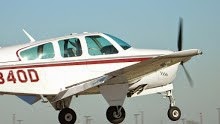
The Bonanza is far removed from the gliders I started out in.  From the outside, it looks about the same size as the Sundowner - the wingspan is only a few inches longer, the fuselage likewise.  The engine cowlings are slightly larger, and it has a 3-bade constant speed prop instead of the fixed 2-blade.

But the experience of flying it (or trying to) is completely different.  It feels like a huge (almost) 300 hp engine with a tiny airplane, basically control fins, behind it. Like a rocket.

Everything about flying the beast is about the engine.  Feeding it, cooling it, trying to slow down for approach, trying to keep up speed with everything hanging out on final.  The airplane itself is sweet, no vices I could detect, but it's all about the IO-520AB in front.

On the runway, following a slow, deliberate pre-flight and checklist, monitored by Instructor Bill, I slowly fed in power - but in vain.  The Rocket bounded to take off speed long before my brain had caught up.  A slight pull on the yoke, and we were climbing at some ridiculous rate, reaching 1600 ft AGL (2200 MSL) before reaching the end of the runway.  Somewhere along the way I managed to pull up the gear.  IB wanted me to level off at 3500ft, but I overshot, ending up at 3800.

I deliberately set very low power (21 in HG and 2300 RPM, or 21/23) to try and slow things down.  A 360 degree standard rate right turn was a little sloppy, but the left 360, followed by two steep turns went to commercial standards.  We did a simulated emergency manual gear down procedure, followed some slow flight (hard to slow down in a Bonanza).  I'm glad I did that, but I wasn't expecting it 30 minutes into my first flight.

Descending and trying to slow down, we made for Sherman (KSWI), and I did my first circuit and landing, followed by 2 more.  By the 3rd one I was feeling in control, so we took off, and headed for the Bonham VOR (BYP) to try out the autopilot and GPSS steering.  We were doing something wrong, and the a/p wouldn't automatically make the turn, but since I have the same GPS and a/p in my Sundowner, I could easily revert to the old way, and set up on the 212 radial for the VOR/DME approach back at McKinney.

My Sundowner, once on the ground rolls and rolls, needing a good amount of braking action.  The Bonanza just stops dead as soon as you pull up the nose for the landing flare.  We easily turned off at Charlie taxiway with almost no braking.  Back in the hangar, IB showed me his comments, and showed me that in his mind, I had met the requirements for a High Power sign off, so he gave me one, right there in my logbook.  So I can now legally fly my Bonanza, but as the insurance (and my peace of mind) require that I have 8 more hours of dual, we'll be flying together for a while more yet.