On February 2nd, 2010, I took and passed the practical FAA examination to add commercial flight privileges to my US pilot license. What this means really are three things:
1. I understand the FAA regulations and recommended procedures well enough to pass the written test with a score of 70% or better (I got a 90%),
2. I can fly well enough to satisfy an examiner that I am able to fly to commercial pilot standards, which are more rigorous than a private pilot needs to attain, and
3. I can therefore be legally employed or hired as a professional pilot.
Thanks to various problems with sickness (not mine), airplane problems (also not mine), and weather (I didn’t cause that either), I had already been forced to postpone this test 4 times. Because the FAA requires that I log 3 hours of training during the 60 days prior to the test, and I had been delayed 3 months, I was forced to do an extra three hours of dual training. Finally, on February 2nd, the weather forecast was for broken clouds at 3,000 feet AGL, which was good enough. Most of the flying test is done relatively low, below that altitude. I figured I could do an instrument climb above the clouds to complete the airwork, and an instrument descent if needed. As it turned out, the clouds all vanished except for some very high cirrus, and it was a beautiful day.
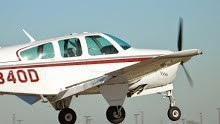
I chose to use 2 airplanes for the test. I own my own Beechcraft Sundowner, and had booked the flying club’s Piper Arrow as well. We could do part of the test in my own airplane, but all of the take offs and landings required in the test must be in a complex airplane, one with retractable undercarriage, and a constant speed propeller. I thought about using just the Arrow, but it was cheaper to use my own as much as possible, plus I felt more comfortable in it after 200+ hours, compared to just 13 hours in the Arrow.
I got to the airport at 1 pm, and arranged with the FBO to park both airplanes next to the terminal building. I got both aircraft out, pre-flighted them, and taxied to the terminal, where I parked them both and loaded three 2.5 gallon water jugs into the back of the Arrow. The Arrow is very nose heavy, and 7.5 gallons of water weighs just over 50 lbs, which I thought would help on the short field stuff, which requires a lot of pulling on the yoke.
Norm, the Examiner arrived just before 2pm. We first sat at the FBO computer, and he reviewed my online application, and my identification documents and logbooks. Then we went into a backroom, and spent about an hour going through the Oral exam. We covered my preparation for a VFR flight plan to Memphis TN, with a fuel and comfort stop in Hot Springs, Ark. Thank goodness for flight planning web sites – I had completed the flight plan using a standard Cessna template, identified waypoints and navigation aids from a VFR sectional, and calculated distance, wind correction and times in the table provided. I also printed out airport diagrams for McKinney (KTKI), Hot Springs (KHOT) and Memphis (KMEM).
I had worked out weight and balance for both aircraft, and based on the results, confirmed from the POH that the balance was acceptable and the weight was below the maximum gross. I had both calculations printed out using MS Excel, and plotted on a photocopy from the Pilot’s Operating Handbooks (POH). I also calculated for the Arrow the takeoff distance and rotation speed, and had the figures from the POH copied and printed.
Finally I had the airport terminal weather forecast (TAF – shows clouds, winds and temperature) and regional forecast and synopsis (METAR) printed, along with the areas of icing, and surface analysis (which shows fronts, lows and highs), and Notices to Airmen (Notams).
I highly recommend doing all of this ahead of time, and bringing it all to the oral. It avoids nervous fumbling, trying to do the calculations under the examiners gaze, and sets the expectation that you are thorough and prepared. I also had my E6B calculator, rulers, pens etc on the table, but we didn’t need them, nor did we refer to the FAR/AIM, but I had it on the table in full view, again to show thoroughness. Norm asked if I was an engineer, because I was so thorough (I was once, but now I work in marketing).
We then covered the rules related to being a commercial pilot, such as what documentation is needed, what rest periods, currency and so on, and what is needed for an airplane to be considered airworthy. We covered airplane systems, aero-medical factors, and basic aerodynamics.
Finally he said “That was a satisfactory Oral”, and let’s go flying. He gave me 10 minutes to get ready, then we got into the Sundowner.
I did a careful “by the book” engine start and taxi, then the run up and pre-takeoff checklist. I got to the passenger briefing, and Norm said “take that as complete”. We did a normal take off from runway 35, and climbed to the North East. At 3,500 ft, Norm asked to perform any 2 of the four performance maneuvers required, which surprised me. I expected that he would tell me which two. I chose (of course) to do my best two, a 55 degree banked steep turn through 360 degrees to the right, followed immediately by the same to the left. I gained some altitude in the first 180 degrees, but was losing it again before going into the opposite bank, lost too much in the second, but recovered and we hit our own slipstream with a solid “thump” on the roll out. I then leveled off, and set up for a chandelle to the right, followed by a slight dive to get back up to cruise speed, then one to the left. At that point, Norm pulled back the throttle and told me that the engine was out.
I trimmed for best glide (75 kts), while looking for a field. I switched tanks, turned on the electric fuel pump, checked all the instruments and pretended to restart. Then I pretended to make a distress call, while gliding towards my chosen field. At that point I noticed the power lines on the approach end, and told Norm I was switching to another field. We arrived over the field about 2,000 ft AGL, so I did the downwind leg as a series of S-turns (I didn’t think I had enough excess altitude to risk a full 360 turn), and extended the base leg, still staying high. I did a 180, and then turned in towards the field. Still high, so I put in full flaps and a sideslip to about 100 feet AGL, at which point Norm said to go around and climb to find a place to do the 8’s.
I climbed to 1,500 ft AGL on a heading of South, and started looking good turning points. 8’s on pylons involved finding 2 turning points, about ½ mile apart, and flying a figure 8 pattern around them, keeping the lateral axis (the wing) pointed directly at the point, and adjusting the radius only by climbing or descending. The first ones I found were water towers, but as we go closer I decided there were too many buildings around, and I selected a different water tower and a road intersection. I entered the 8’s at 1500 ft. Every time the point moved ahead of the wing in a turn, I pushed on the yoke, when it moved back, I pulled. We went around twice, before Norm said that was enough and to head back to the airport to switch airplanes.
I climbed to 1800 feet, checked ATIS on radio #2, and contacted the tower for permission to land, which we got right away. After landing, I cleaned up the airplane on the taxiway, and Norm commented that we hadn’t done any slow flight or stalls. I hadn’t practiced those in the Arrow, so I debated about telling him we would take off again, but decided to take a chance. The Arrow isn’t that hard to fly, only to land softly!
We switched into the Arrow, and I again careful followed the checklist, and again Norm said to take the passenger briefing as read. I had noticed during my instrument check ride with him that he gets to a point where he thinks you are good enough, and then he is willing to cut a little slack. I think he was at that point now.
We did a normal field take off, and climbed to 3500 ft. I didn’t accelerate to cruise – I went straight into slow flight at 60 kts. Norm asked me to turn to a heading of North, then a turn to East, without changing altitude or speed. It wasn’t hard – the Arrow flies in that domain very like the Sundowner. He then asked to show an approach to landing stall first straight ahead, and then in a 30 degree turn to the right. I lowered the wheels and flaps, and did the stalls with little drama. The Arrow has a very strong pre-stall shudder, the stalls quite benignly. We then did full power climb out stalls, straight ahead and then in a left turn. Again, easy. In fact it was easier than in my own airplane. I needed less rudder, and the wing drop was more gentle. Perhaps I was just more coordinated.
Now we headed back towards the airport, I lost height in a serried of S-turns. I picked up ATIS, and called the tower, and was told to enter a right downwind for runway 35, cleared for touch and go, number 4, follow the Cessna ahead. I told the tower the sun was right ahead and I couldn’t see the traffic, so he said he would call my base turn. In the meantime I ran the GUMPS checklist, and Norm asked me to do a short field approach, over a 50 foot tree right at the threshold.
The key in the Arrow is to get set up early, so I had full flaps and 70 kts on the ASI on the base leg, and turned onto the final approach leg a shade high. I scarcely had to touch anything – full flaps, full propeller speed and gear down, 16 inches of manifold pressure at 70 kts gives a nice 400 ft/min descent, right on the glide slope. I also knew that the VASI lights were set for 50 feet over the threshold (same as the ILS glideslope), so I kept 3 white and 1 red all the way down (1 degree high).
We landed perfectly, and Norm said not to slow up, but to do a soft field take off. I set the flaps to 25 degrees, and pulled back on the yoke to lighten the nose, and added full power. I let the nose come off at 57 kts, and we climbed to just above the runway. Accelerate to 70 kts, bring in the flaps, accelerate to 87 kts before climbing and raise the gear.
He then told me the next one was to be a soft field landing, which is almost the same as a short field landing, except that you keep a little power on and try to land as softly as you can. Following that, he told me to do a short field takeoff (again, very similar to the soft field takeoff, except that you don’t raise the nose until reaching flying speed), followed by a power off 180 degree precision landing.
McKinney was flying right traffic, which put me on the side away from the runway. I asked the tower if I could fly a left traffic pattern instead, for a power off close in approach. They agreed, so I turned left, and told Norm my touchdown point would be the 1000 ft touchdown zone (TDZE) markers, the biggest, fattest stripes on the runway. I was cleared to land, and opposite the stripes I pulled the power to idle. Instantly the gear up warning siren started. I trimmed for 79 kts as I turned towards the runway, making for the very south most end. Once I was sure I had the runway made, I lowered the gear, and 2 notches of flaps. I turned to align with the runway over the numbers at about 250 ft, and threw in the final notch of flaps, and a slideslip too. I straightened out and flared over the TDZE stripes, but with a little too much speed, and we floated.
Fortunately the test standard says the touchdown has to occur within 100 feet of the selected point, and I think I used 99 of them. Bu the wheels finally touched (very softly!), and Norm said to take off again, which surprised me. I thought we were done. But off we went again, and Norm told me to set up for a normal landing, but to go around again at 100 feet. I asked for and received permission for a low approach, and set up to land with full flaps, 17 inches and 80 kts. At slightly under 100 feet (again I was using the VASI lights as guidance, and was just short of the threshold), I added power, stopped the descent and took off 1 notch of flaps. Once I had a climb, I took off the second notch, and raised the gear. Finally once I had 87 kts in a climb, I brought in the last notch. In the climb, Norm stuck his hand over and said “Congratulations! You’re a Commercial Pilot!”
I set up for a right downwind, called the tower and asked to land, and said “I passed!” (I had already told the tower operator the day before that I would be doing my commercial test). He said “congratulations!” and cleared me to land. I repeated the clearance, and added “Better not screw up this landing!” It was a normal approach and landing, although my nerves were actually tighter than during the test!